
Fabrizio montesdeoca is a good men he knows how to talk to customer and confidence them.
a month ago
Aluminum roofing systems in South Miami typically last 30+ years, with 24-gauge standing-seam panels carrying 30 to 40 year manufacturer coating warranties on Kynar 500 or PVDF finishes. The material forms a self-healing oxide layer that reforms within seconds of any surface abrasion, which resists salt-air corrosion roughly 8 miles inland from the Atlantic. South Miami sits between the bay and inland neighborhoods, where salt exposure varies by how close you are to water.
Aluminum roofing systems in South Miami typically last 30+ years in the area's coastal climate, with 24-gauge standing-seam panels carrying 30 to 40 year manufacturer coating warranties for the Kynar 500 or PVDF finish. The self-healing aluminum oxide layer reforms within seconds of any surface abrasion, which protects against salt-air corrosion 8 miles inland from the Atlantic and prevents the rust-through failures common to steel-based systems over the same service life.
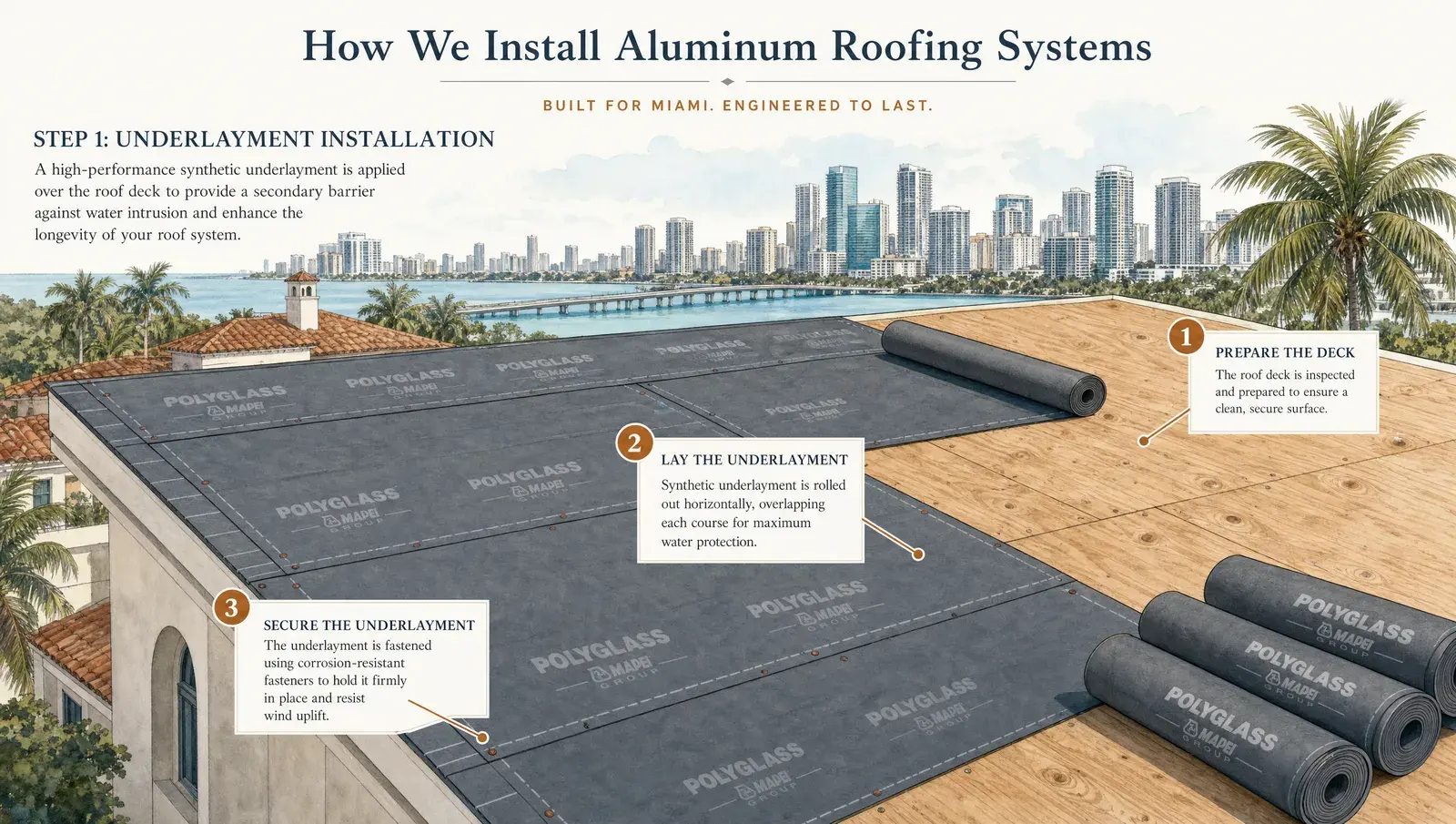
Aluminum roofing installation begins with deck inspection and preparation.
South Miami's location creates specific roofing challenges. The area sits close enough to the coast for salt air exposure but far enough inland that some homes face different conditions than waterfront properties. Aluminum handles both through its corrosion-resistant oxide layer.
The material science matters here. When aluminum oxidizes, it forms a protective barrier that prevents further corrosion. Steel keeps rusting once the protective coating fails.
In South Miami's humid, salt-laden air, this self-healing property extends roof lifespan significantly.
South Miami's building stock includes mid-century ranch homes with low-slope roofs, Mediterranean revivals with tile-style profiles, and contemporary designs requiring clean lines. Aluminum accommodates all three through different panel profiles. Standing-seam panels suit modern architecture. Corrugated profiles work for ranch-style homes. Tile-profile aluminum panels replicate Mediterranean aesthetics at lower weight.
Miami-Dade County's High-Velocity Hurricane Zone requirements apply throughout South Miami. Aluminum standing-seam systems meet these requirements when installed with approved fastening patterns and tested underlayment systems. The material's light weight reduces structural load while maintaining wind-uplift resistance.
| Material | Lifespan | Weight | Corrosion Resistance | Relative Cost |
|---|---|---|---|---|
| Aluminum | 30+ years | 0.5-0.7 psf | Excellent in salt air | Mid-range |
| Galvalume | 30+ years | 0.8-1.2 psf | Good, degrades in coastal zones | Economical |
| Copper | 30+ years | 1.5-2.0 psf | Excellent, patinas naturally | Premium |
| Steel (painted) | 30+ years | 1.0-1.5 psf | Poor without intact coating | Budget |
Aluminum roofing installation begins with deck inspection and preparation. We remove existing roofing down to the deck, assess sheathing condition, and replace damaged sections before underlayment goes down. South Florida's moisture exposure means older decks often show rot or delamination that has to be addressed before new roofing installs.
Underlayment selection depends on roof pitch and exposure. Low-slope applications require self-adhering membranes that seal around fasteners and resist water intrusion. Steeper pitches use synthetic underlayment with higher tear strength than felt. We install underlayment in overlapping courses, sealing seams and penetrations to create a secondary water barrier.
Aluminum panels run from ridge to eave in continuous lengths, eliminating horizontal seams where water can enter. Standing-seam profiles use concealed clips that attach to the deck through the underlayment, allowing the panel to expand and contract with temperature changes without stressing fasteners. Panels snap or crimp together along raised seams, creating a weather-tight joint.
Flashing details at walls, chimneys, and roof penetrations require careful integration with the panel system. We fabricate custom flashing from the same aluminum coil as the panels, matching finish and gauge. Proper flashing prevents water from migrating behind panels or into wall cavities.
Ridge caps, hip caps, and rake trim complete the installation. These components attach over the panel seams, covering fasteners and creating finished edges. South Miami's wind exposure requires mechanical attachment rather than adhesive-only systems. Every component has to meet HVHZ testing standards.
We install aluminum roofing systems across South Miami's residential building types. Standing-seam aluminum suits contemporary homes and mid-century modern architecture where clean lines matter. The vertical panel seams create shadow lines that emphasize horizontal building forms.
Corrugated aluminum works for ranch-style homes and properties where exposed-fastener systems fit the architectural character. The corrugated profile sheds water quickly on low-slope applications and costs less than standing-seam systems. South Miami has many ranch homes from the 1950s and 1960s where this profile matches the original design intent.
Tile-profile aluminum panels replicate Mediterranean and Spanish Colonial roof aesthetics at lower weight and cost than clay or concrete tile. These panels interlock like tile but weigh a fraction of the original material. South Miami's Mediterranean revival homes sometimes require tile appearance for neighborhood consistency, and aluminum tile profiles satisfy that requirement without the structural load.
Each aluminum system requires different flashing details, fastener types, and installation techniques specific to the panel profile and roof pitch. The choice depends on your home's structural capacity, architectural style, and budget.
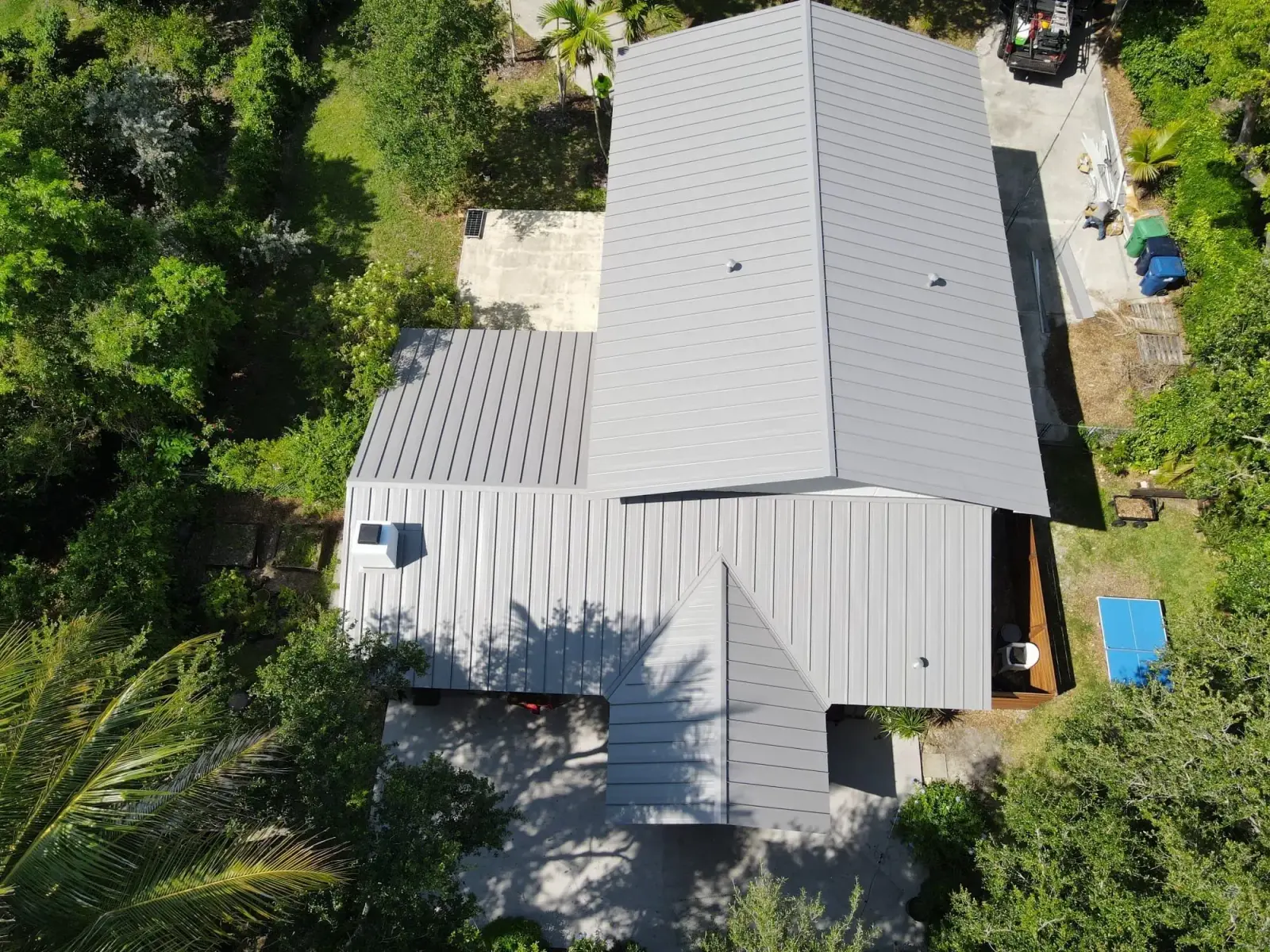
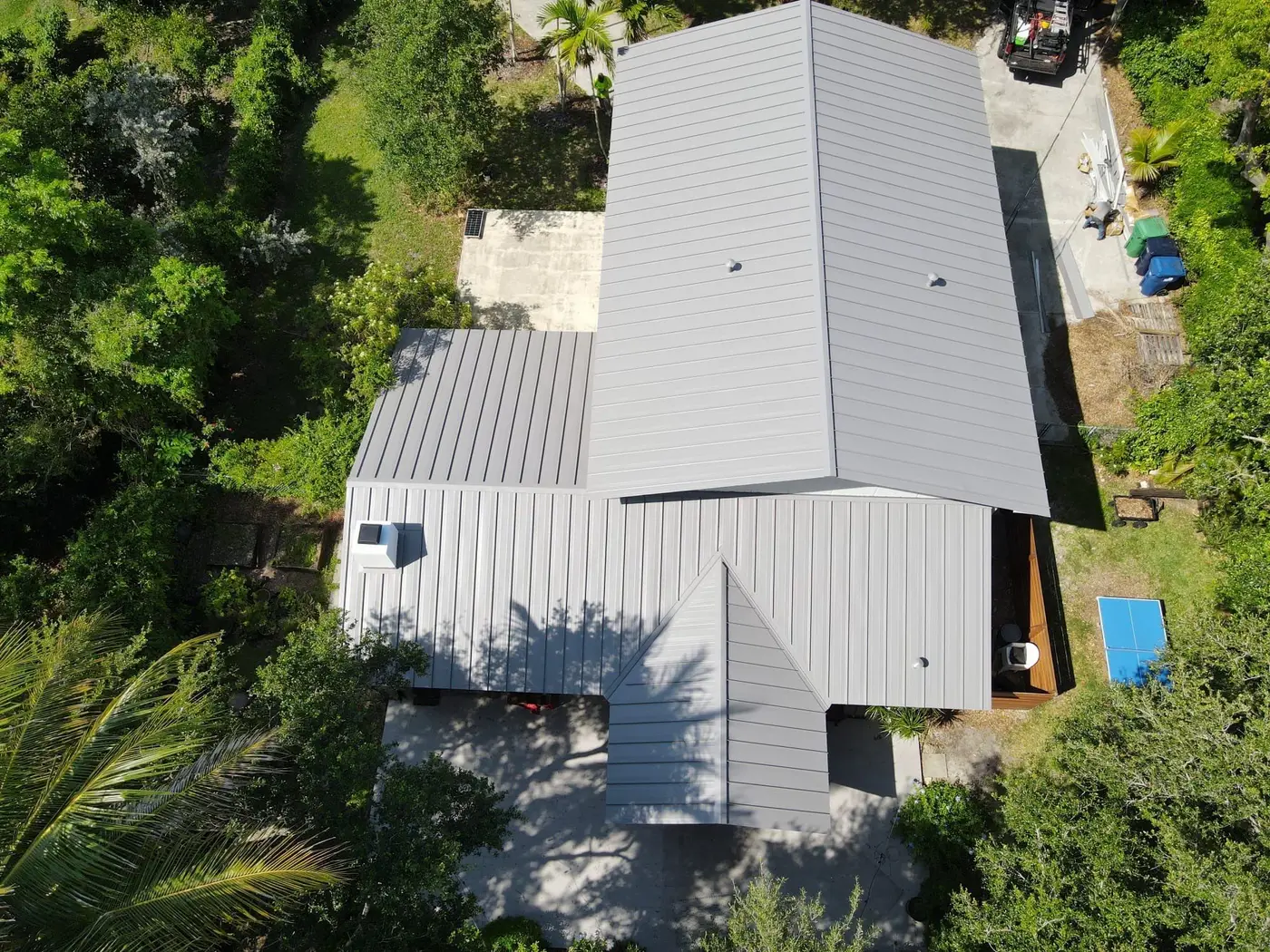
Our recent South Miami aluminum work includes a single-story residence that received an aluminum standing-seam roof replacement, set against the palm-shaded landscape common to the city's older lots. Standing-seam aluminum suits this kind of low, horizontal South Miami home because the continuous vertical panels read as a clean plane rather than a textured surface, and the factory PVDF finish holds its color through the city's year-round UV load without the recoating a site-painted roof would eventually need.
Across South Miami we also re-roof and repair older exposed-fastener metal that no longer meets the current wind code. Those older panel systems tend to loosen at the fastener line first, so a replacement aluminum standing-seam roof moves the attachment to concealed clips and brings the fastening pattern up to the Miami-Dade uplift standard, tightening clip spacing in the perimeter and corner zones where wind pressure runs highest.
A typical South Miami aluminum standing-seam installation runs five to seven days for a straightforward gable or hip roof, longer for complex geometries with multiple valleys, dormers, or skylights. The first day covers tear-off and deck inspection. South Miami's salt-air exposure and tree-canopy moisture combination accelerates decay on roof decks older than 20 years, so we plan budget contingency for sheathing replacement on most homes built before 2005.
Day two installs synthetic high-temperature underlayment rated to 250 degrees Fahrenheit with self-adhered ice-and-water shield at eaves, valleys, and penetrations. HVHZ regulations require sealed underlayment seams and specific overlap dimensions documented on the permit drawings. Days three through five handle field panel installation working from rake to ridge, with each panel running ridge-to-eave in one continuous piece to eliminate horizontal seams where wind-driven rain can enter.
Concealed-clip spacing on a South Miami installation follows the Miami-Dade Notice of Acceptance assembly for the specific aluminum panel and underlayment combination. Field-zone clips typically space 12 to 24 inches on center, tightening to roughly half that spacing in the perimeter and corner zones where wind-uplift pressures run 1.5 to 2 times the field-zone pressure. We use stainless or coated-steel screws into the deck rather than uncoated fasteners, which prevents the rust staining that develops under salt-air exposure at unprotected fastener heads.
Istueta workmanship warranty on a South Miami aluminum standing-seam installation runs up to 12 years on installation labor, separate from the manufacturer's coating and material warranties. The workmanship warranty covers fastener integrity, seam engagement, and flashing details: the items most likely to develop issues from install error rather than material defect. We document every fastener count, clip placement, and flashing detail with photos at install milestones, which supports warranty claims if anything develops in the field.
Annual inspections take 1 to 2 hours and focus on flashing condition at chimneys, skylights, and roof-to-wall transitions; fastener tightness in any exposed-fastener trim sections; debris accumulation in valleys; and overall gutter and downspout flow. We offer a maintenance program covering the annual inspection plus minor flashing touch-up and sealant refresh, which extends the system's reliable service life and supports the manufacturer's coating warranty terms. Most South Miami aluminum installs require no significant intervention through the first 15 to 20 years of service when maintained on this annual cadence, with the manufacturer's 30 to 40 year coating warranty remaining valid through that window.
Homeowners weighing alternative metal profiles often compare aluminum to the broader South Miami metal roofing portfolio, where copper roofing in South Miami offers the longest service life and Galvalume roofing in South Miami sits below aluminum on the price ladder while still meeting HVHZ standards. For non-metal options on the same home, South Miami tile roofing remains the traditional Mediterranean choice; the full neighborhood scope of materials and services we install is documented on Istueta's South Miami roofing services page.
For more information about aluminum roofing, see our aluminum roofing guide.
Schedule a no-pressure consultation. We walk your roof, review your options, and give you a detailed written proposal.