
(Translated by Google) Thanks to their good prices, quality, and work guarantee, I am now a satisfied customer. Thank you. (Original) Gracias a sus buenos precios, calidad y garantía del trabajo, hoy soy un cliente satisfecho. Gracias
4 weeks ago
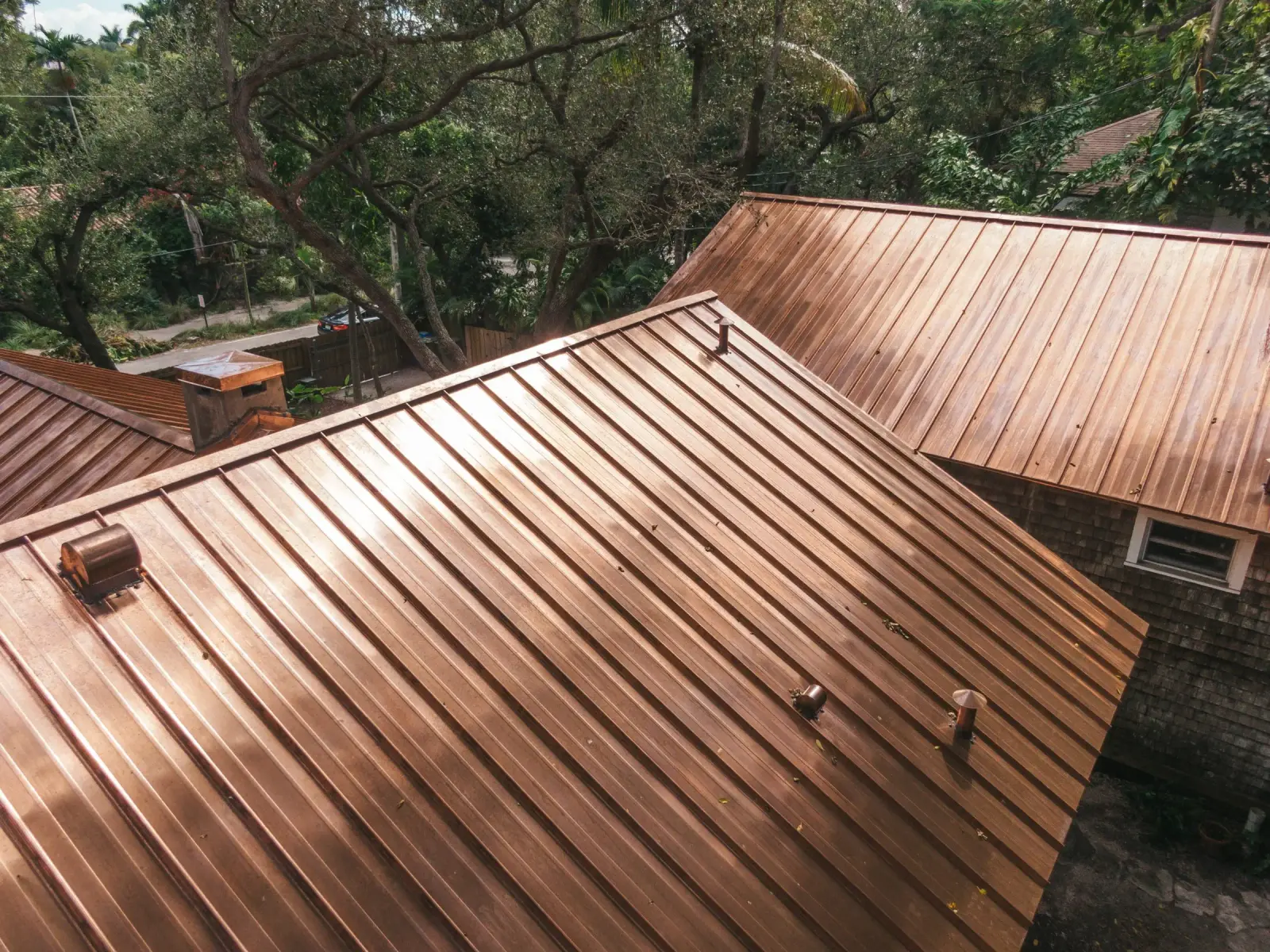
Copper roofing in South Miami offers long-term protection for homes in a coastal environment where salt air and heat test every material. We've installed copper roofing systems across South Florida since 1985, with an approach that focuses on proper installation, material selection for coastal conditions, and clear communication throughout the process.
Copper roofing systems in South Miami typically last 30+ years when properly installed and maintained. The material forms a protective patina layer that shields the underlying copper from further corrosion, making it one of the longest-lasting roofing materials available for coastal environments.
Copper installation requires attention to thermal movement, fastener compatibility, and seam detailing.
South Miami's building stock includes Mediterranean revival homes, mid-century modern structures, and contemporary designs. Copper roofing complements both historic character and modern architectural lines.
The neighborhood sits approximately 8 miles inland from the Atlantic coast, experiencing salt air exposure without direct oceanfront conditions. Copper's patina formation provides corrosion resistance in this environment, developing a protective verde layer over 7 to 15 years depending on exposure levels.
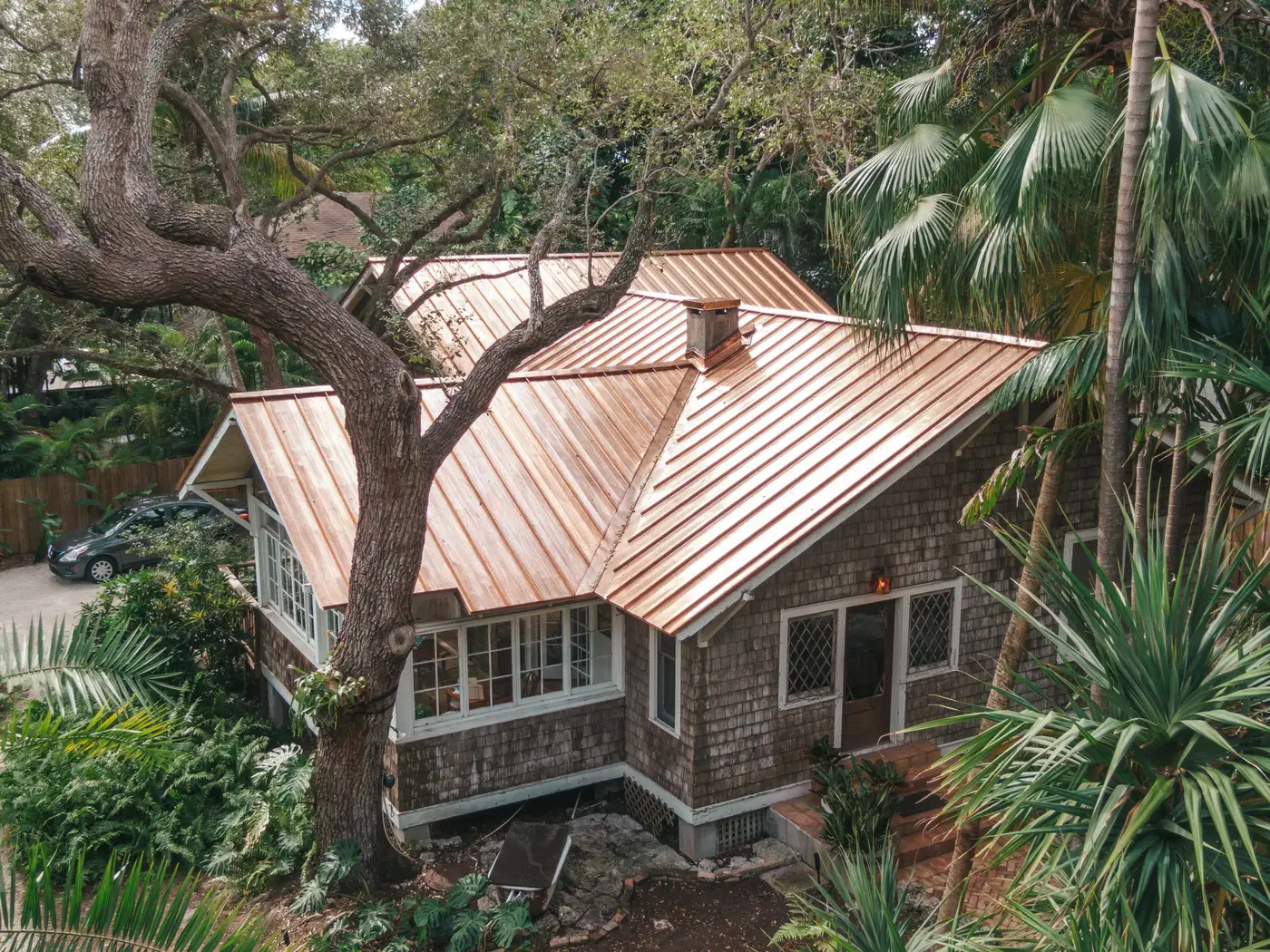
South Miami's permitting process through Miami-Dade County requires HVHZ compliance for all roofing installations. Copper standing-seam systems meet these wind-uplift requirements when installed with proper clip spacing and fastener schedules. The material's ductility allows for thermal expansion without fastener failure, a consideration in South Florida's temperature range.
Architectural review in certain South Miami districts evaluates material appropriateness for historic structures. Copper roofing often receives approval for Mediterranean revival and Spanish Colonial homes where clay tile replacement isn't feasible due to structural load limits.
South Miami is its own incorporated city of about 2.3 square miles, and its Cambridge Lawns Historic District preserves Tudor Revival and Mediterranean revival homes from 1928. On that housing stock copper is often the material that satisfies design review, because it was used historically on these styles for valleys, gutters, finials, and decorative cresting. Where a home's original clay tile has failed and the framing cannot carry a replacement, copper offers a material of comparable weight to clay and lighter than concrete tile, close enough to swap without reframing.
The city absorbed damage from both the 1926 Miami hurricane and Hurricane Andrew in 1992, and homeowners here tend to expect fastening that exceeds the Miami-Dade wind standard rather than just clearing it. Copper standing-seam meets that HVHZ uplift requirement through concealed clips and a soldered or mechanically seamed panel, and the metal's ductility lets it expand and contract through South Florida's temperature range without stressing the fasteners.
The mature oak and palm canopy that shades much of South Miami works in copper's favor rather than against it. There is no paint film for a falling frond or branch to scratch through, so the patina keeps developing under debris and shade toward its stable verdigris. Our own office sits at 5966 S Dixie Hwy inside the city, on the commercial corridor that runs past the University of Miami along Red Road, so the crews on these roofs are working their own service area.
| Material | Lifespan | Patina/Finish | Relative Cost | Maintenance |
|---|---|---|---|---|
| Copper | 30+ years | Natural verde patina | Premium | Minimal; drainage cleaning |
| Aluminum | 30+ years | Factory coating or mill finish | Mid-range | Coating inspection every 10-15 years |
| Galvalume | 30+ years | Metallic gray or painted | Economical | Coating touch-up in high-salt areas |
| Zinc | 30+ years | Natural gray patina | Premium | Minimal; similar to copper |
Copper installation requires attention to thermal movement, fastener compatibility, and seam detailing. We follow manufacturer specifications and building code requirements for South Florida's High Velocity Hurricane Zone.
The process starts with deck preparation. We verify the roof deck is structurally sound and properly ventilated. Underlayment goes down next: a high-temperature synthetic that won't degrade under copper's heat absorption.
Standing-seam copper panels run vertically from ridge to eave. We fasten clips to the deck with corrosion-resistant screws. The copper panels snap into these clips, allowing the metal to expand and contract without stressing the fasteners. This floating attachment is critical for long-term performance.
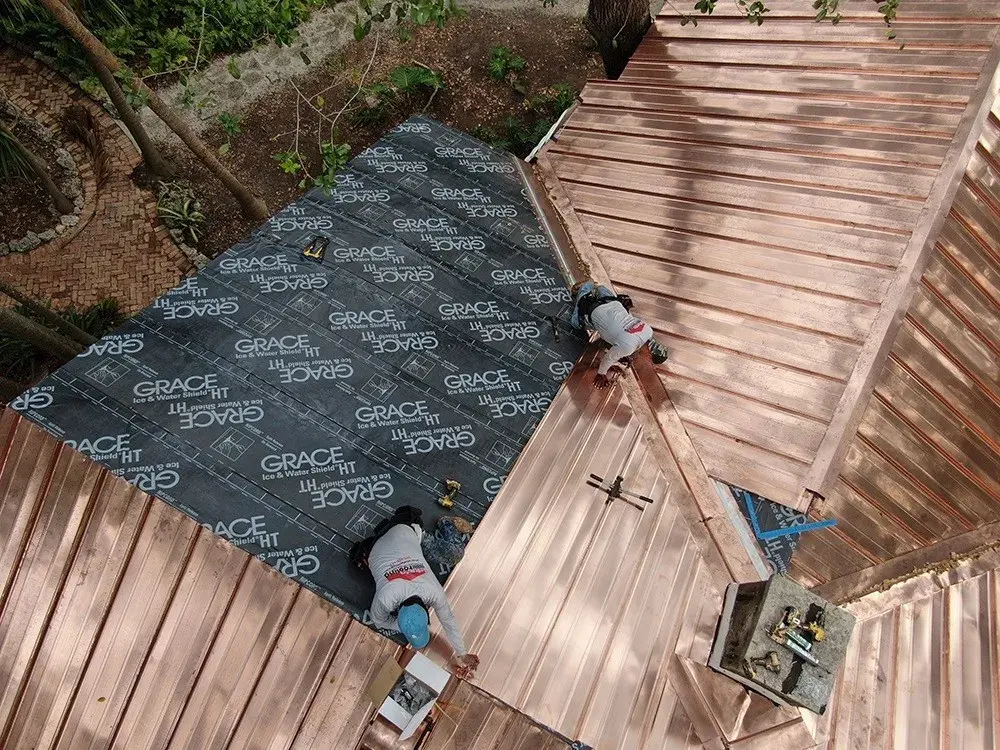
Seams get mechanically locked: either single-lock or double-lock depending on roof pitch and exposure. We don't rely on sealants for primary weather protection. Properly formed seams shed water through geometry, not adhesives.
Flashing details matter most at valleys, chimneys, and roof-to-wall transitions. We hand-form copper flashing to match the panel profile and make sure water flows away from vulnerable areas. Soldered seams provide permanent connections where panels meet complex geometry.
The fasteners themselves are chosen for chemistry, not just holding power. Copper clips seat at roughly 12-inch intervals along each seam and take stainless-steel screws, because copper in contact with aluminum, galvanized steel, or zinc corrodes where South Miami's humidity bridges the two metals. Copper and stainless are the only combination we let touch on these roofs.
Soldered joints carry the vulnerable details. A soldered valley or flat-seam resists both capillary draw and the wind-driven rain that South Miami's summer storms push upslope, and valley flashing formed from the same copper runs about 12 inches under the panel on each side to keep that water on top of the metal. Where the roof drains to gutters, we carry the copper through to copper gutters and downspouts so the whole assembly stays one metal and the galvanic problem never starts.
Copper roofing in South Miami sits at the premium end of the metal roofing market, priced above aluminum and galvalume because of the material cost and the specialized labor it demands. The installed price depends on roof complexity, panel profile, and project scope, and it covers material, labor, underlayment, flashing, and fasteners. Complex roof geometries with multiple valleys, dormers, or steep pitches increase labor requirements and material waste, which is why most copper projects land toward the upper end of the typical $25,000 to $80,000+ roof-replacement range.
The cost reflects both material expense and installation expertise. Copper requires specialized tools, soldering skills, and knowledge of thermal movement detailing. A properly installed copper roof is a multi-generational investment: your children will inherit this roof.
Financing options are available for qualified homeowners through third-party lenders. Terms and rates vary by program and are subject to credit approval. Contact us to discuss current financing options and payment structures.
Copper fits the mix of homes South Miami holds because the seam detail changes with the house. On the city's Mediterranean Revival homes, standing-seam copper follows the hips and valleys with hand-formed flashing and ridge details that match the period character. On the mid-century modern homes and their low, horizontal rooflines, a low-profile standing-seam or flat-seam copper reads as a clean plane rather than a textured surface, so the roof sits with the architecture instead of competing with it. Sixteen-ounce copper covers most residential fields, with the heavier twenty-ounce reserved for the highest-exposure roofs.
Coastal exposure is what drives many South Miami homeowners to copper in the first place. Owners replacing a second or third roof often move to copper to step off the replacement treadmill, since the metal's performance in salt air and its resistance to wind uplift make it a practical choice for long-term coastal ownership. Because copper carries no coating to fail, the salt-air corrosion that shortens the life of lower-tier metals never gets a foothold.
Copper roofing is the premium metal option for South Miami homes, with a 30+ year lifespan and no factory coating that can fail. The material's natural patina formation eliminates the coating maintenance required for painted metal roofing.
Aluminum roofing carries a lower installed cost than copper while still providing 30+ years of service life. Aluminum's lighter weight makes it suitable for homes with load restrictions, and factory coatings provide color options copper doesn't offer.
Galvalume roofing combines steel strength with an aluminum-zinc coating, delivering 30+ years of performance at the most economical point on the metal price ladder. The material works well for contemporary designs where the metallic gray finish complements modern architecture.
Your material choice depends on budget, aesthetic preference, and performance priorities. We provide copper samples, aluminum panel options, and galvalume profiles during the consultation process, along with performance data for each material in South Florida's coastal environment.
For homeowners weighing copper's long service life against a shorter ownership horizon, asphalt shingle roofing in South Miami remains a viable alternative at a small fraction of copper's installed cost. Asphalt systems in South Florida typically last 15+ years, so a shorter-horizon owner may come out ahead on a lower-cost material that gets replaced once or twice within a single copper roof's lifetime. We lay out that trade-off between upfront cost and service life during the consultation when both options are on the table.
We've installed roofing systems in South Miami since 1985. Our office at 5966 S Dixie Hwy, Suite 300 puts us in the neighborhoods we serve. You're working with a local team that understands South Florida's building codes, permit requirements, and coastal exposure challenges.
Copper installation requires specific expertise. Our team holds certified applicator status with metal roofing manufacturers including Englert, PAC-CLAD, and Berridge. This certification means we've completed manufacturer training on proper installation techniques, fastener selection, and seam detailing, and we hold active membership in the National Roofing Contractors Association, which keeps our crews current on the metal-roofing standards these installations answer to. You get the manufacturer's full warranty coverage when we install their products, with Istueta backing every install with a workmanship warranty of up to 12 years in addition to the manufacturer's coating and material warranties.
We've outlived our own workmanship warranty 3.5 times over. That longevity matters when you're investing in a roof that will last 30+ years. The company that installs your copper roof should still be here when you need service or inspection decades from now.
Our approach prioritizes clear communication and realistic expectations. We walk you through material options, explain the installation process, and discuss maintenance requirements before you commit. You'll know what to expect at each stage of the project.
See manufacturer warranty certificate for coverage terms and conditions.
For more information about copper roofing, see our copper roofing guide.
Schedule a no-pressure consultation. We walk your roof, review your options, and give you a detailed written proposal.