
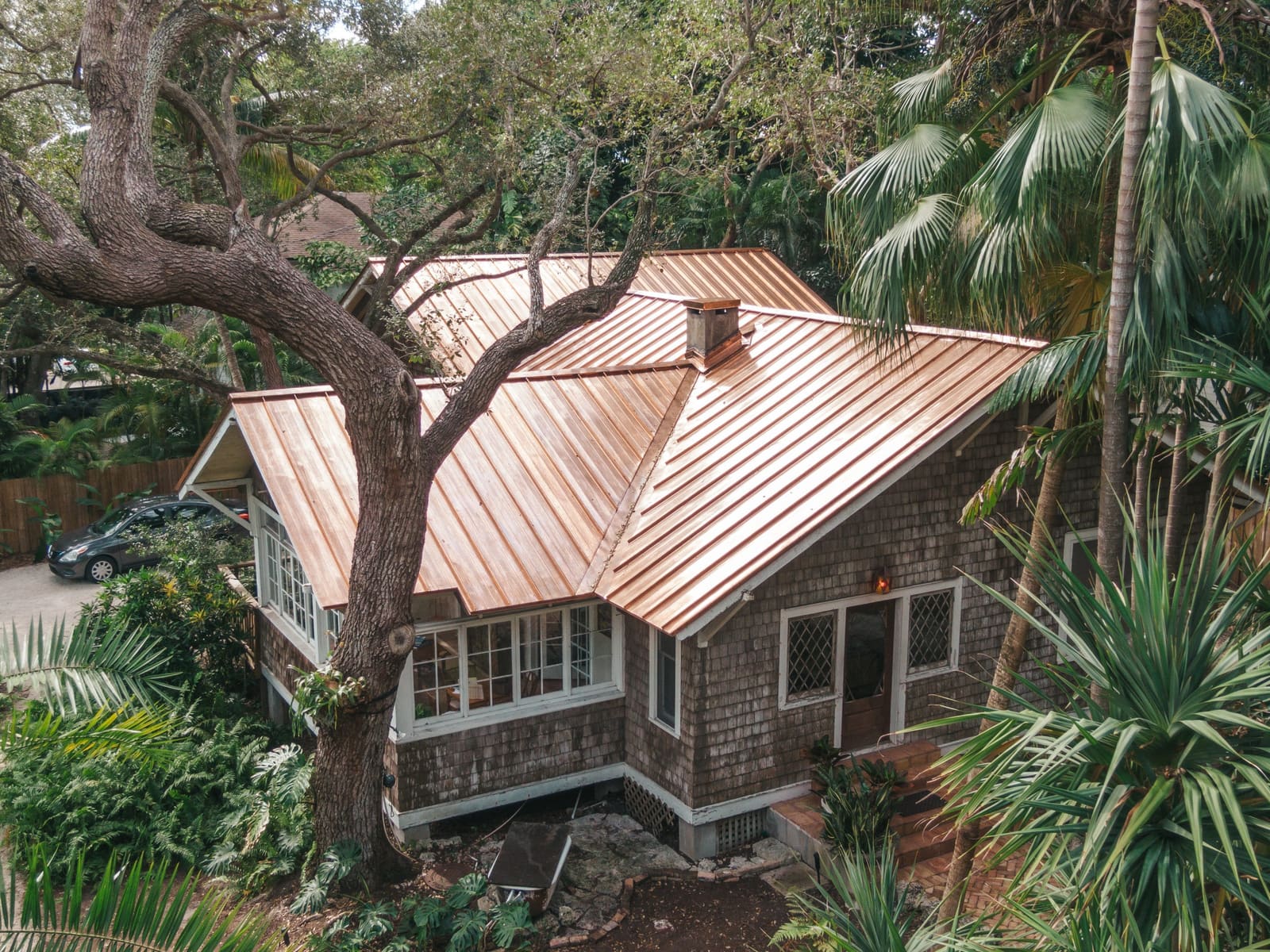
The custumer services was excellent!!! Ramon Alvarez did a very professional and nice job !
a week ago
Copper roofing is the material that outlasts the contractor who installs it. It forms a protective patina that resists salt air, hurricane wind, and decades of Miami coastal exposure. Istueta Roofing has installed copper systems across South Florida since 1985, earning the Metal Roofing Alliance Q1 2023 Award for executed copper work in this market.
Copper roofing lasts 30+ years in South Florida's coastal climate. The material forms a self-healing patina layer that resists salt-air corrosion and UV degradation. Standing-seam copper systems installed with concealed-clip fastening and soldered seams meet Miami-Dade HVHZ wind-uplift requirements and carry manufacturer material warranties spanning multiple decades.
Salt air accelerates corrosion on ferrous metals and galvanized coatings.
Copper roofing is a standing-seam metal roofing system installed on sloped residential and commercial structures. The material ships as 16-ounce or 20-ounce copper coil, formed into panels with raised seams that interlock and shed water without penetrating fasteners on the roof surface.
The scope includes standing-seam panel installation, soldered or mechanically seamed joints, concealed-clip fastening to the roof deck, copper flashing at valleys and ridges, and copper trim at eaves and rakes. Copper gutter systems and downspouts are specified alongside the roof to maintain material continuity and eliminate galvanic corrosion between dissimilar metals.
Copper roofing is not a retrofit overlay. The existing roof is removed to the deck, the deck is inspected and repaired, a high-temperature underlayment is installed, and the copper panels are formed and fastened per the manufacturer's standing-seam specification. The installation is a complete roof replacement, not a cosmetic upgrade.
Miami-Dade County is a High Velocity Hurricane Zone. Copper standing-seam systems installed with Miami-Dade NOA-approved clips and fastening schedules meet the 200+ mph uplift requirement that applies to new construction and major roof replacements in this jurisdiction.
Salt air accelerates corrosion on ferrous metals and galvanized coatings. Copper does not rust. It forms a protective verdigris patina that self-heals when scratched and resists further oxidation.
The patina develops naturally in about 5 to 7 years in Miami's seacoast air (10 to 14 sheltered or inland), transitioning from bright copper to brown to green. The green patina is the material's final stable state.
Copper roofing is specified on historic properties in Coral Gables, Coconut Grove, and Miami Beach where design review boards require material authenticity and longevity. The material matches the architectural character of Mediterranean revival, mid-century modern, and contemporary coastal residences. Copper does not fade, chalk, or degrade under UV exposure the way painted finishes do.
Neighborhoods including Pinecrest, Key Biscayne, and Gables Estates specify copper for its combination of hurricane performance, salt-air resistance, and multi-generational lifespan. The material investment is recovered across decades of service without re-roofing cycles.
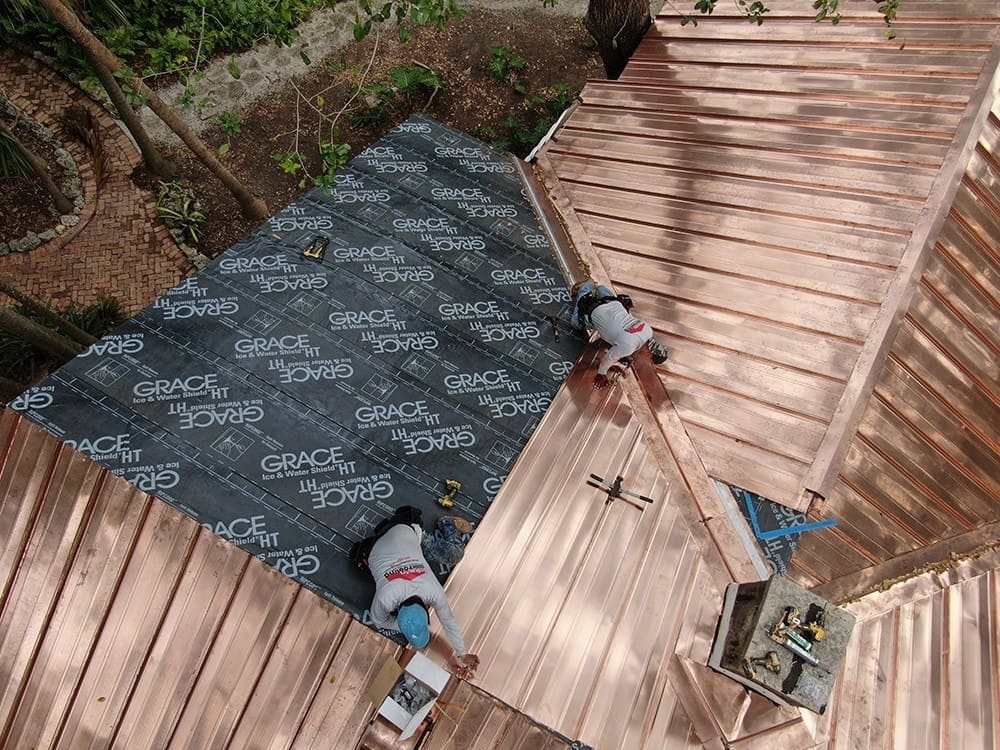
Installation begins with complete tear-off to the roof deck. The deck is inspected for rot, fastener pull-through, and structural deflection. Damaged sheathing is replaced with CDX plywood or OSB rated for the fastener schedule.

A high-temperature synthetic underlayment is installed over the deck with 6-inch overlaps and fastened per the manufacturer's specification. The underlayment provides a secondary water barrier and protects the deck during the panel installation sequence.
Standing-seam copper panels run from ridge to eave in continuous lengths when the slope allows. Panels are formed on-site or pre-formed to the roof's dimensional requirements. Concealed clips are fastened to the deck at 12-inch intervals along the panel seam, and the panel edge locks into the clip without penetrating the copper surface.
Seams are either mechanically seamed with a hand seamer or soldered. Soldered seams provide a watertight joint that resists capillary action and wind-driven rain. Mechanical seams are faster to install and allow for thermal expansion without solder cracking.
Copper flashing is fabricated for valleys, ridges, chimneys, and wall transitions. Valley flashing is soldered at the seams and extends 12 inches under the panel on each side. Ridge caps are formed from the same copper coil as the panels and soldered or mechanically seamed to the ridge line.
Eave and rake trim is formed from copper coil and fastened to the fascia with stainless-steel fasteners. Copper and stainless steel do not react galvanically. Aluminum, galvanized steel, and zinc fasteners are not used in contact with copper. They corrode when moisture bridges the dissimilar metals.
Copper gutter systems are specified to match the roof material. Half-round or K-style gutters are fabricated from 16-ounce or 20-ounce copper and soldered at the seams. Downspouts are copper, and the gutter hangers are copper or stainless steel.
The gutter system is installed after the roof panels are in place, and the eave trim is integrated with the gutter back to prevent water from running behind the gutter.
| Material | Lifespan | Coastal Corrosion Resistance | Patina Development | Installed Cost |
|---|---|---|---|---|
| Copper | 70–100+ years | Self-healing patina resists salt air | Develops protective verdigris over 7–15 years | high-end |
| Metal roofing aluminum | 50+ years | Self-healing oxide layer resists salt air | No patina; maintains mill finish or painted surface | Moderate |
| Metal roofing galvalume | 40–60 years | Zinc-aluminum coating resists corrosion; degrades faster in salt air than copper or aluminum | No patina; coating weathers to matte grey | Moderate |
Copper does not require painting or coating. The patina is the material's final finish. Aluminum and Galvalume systems are typically painted with Kynar or similar coatings to extend lifespan and provide color options. Painted finishes require inspection and potential re-coating after 20 to 30 years.
Copper is heavier than aluminum and lighter than steel. The material does not require structural reinforcement on standard residential framing when the deck is sound and the fastener schedule is followed. Copper's weight is comparable to clay tile and lighter than concrete tile, making it a viable replacement for a tile roof of either profile without reframing.
Copper material carries manufacturer warranties spanning decades. The material itself does not degrade under UV exposure or salt-air corrosion, and the patina layer is self-renewing. Manufacturer warranties cover material defects, not patina color variation or surface weathering.
Our Istueta 12-Year Workmanship Warranty backs the copper installation: fastener pull-through, seam separation, flashing leaks, and installation defects that result in water intrusion. Copper does not require the substrate or PVDF paint warranties used on galvalume and aluminum systems. The metal itself is the warranty, and the patina is its protective finish. Manufacturer warranties on copper material per manufacturer terms.
Specific coverage and exclusions documented in your signed proposal and contract.
The license qualifier is the owner. NRCA membership supports technical authority for specialty metal roofing installations. The Metal Roofing Alliance Q1 2023 Award for South Florida copper roof project demonstrates executed expertise in this high-end material category.
Copper roofing carries high-end pricing. The material cost is higher than aluminum, Galvalume, asphalt shingles, or tile. The installation labor is specialized. Soldering, panel forming, and concealed-clip fastening require trained crews. Financing options reduce the barrier to entry. Monthly payment plans spread the investment across terms that roof's multi-decade lifespan. Financing subject to credit approval. See terms for details.
Copper roofing pricing scales with material weight (16-ounce vs 20-ounce), panel profile (standing-seam vs flat-seam), seam method (mechanical vs soldered), roof complexity (valleys, dormers, chimneys), and the scope of copper trim and gutter integration.
A simple gable roof with minimal penetrations costs less per square foot than a hip roof with multiple valleys, skylights, and chimney flashing. Soldered seams add labor time compared to mechanical seams. Copper gutter systems add material and fabrication cost.
The investment is recovered across the roof's lifespan. Copper does not require re-roofing on the cycle demanded by roof shingles or epdm roofing do. The material outlasts the building's mortgage term and transfers value to the next owner.
Copper roof shingles are individual metal panels formed to look like traditional shingle, shake, or scallop shapes, cut from solid copper sheet instead of stamped from steel or aluminum. Each piece is fastened with copper nails or clips so the whole assembly stays one metal, which matters because copper reacts with other metals over time. Rather than a single large panel run, shingle-style copper is laid course by course much like a slate or clay roof, which is why it shows up most on older homes, dormers, turrets, and accent roofs where a fielded panel run would look out of place.
What sets copper apart from other metal roofing is the finish itself. There is no paint or PVDF coating to apply or maintain, because copper forms its own protective patina as it weathers, shifting from bright reddish-orange to brown and eventually a green-gray surface. That patina is the finish, not a coating over it, which is a different maintenance conversation than a Kynar 500 painted steel or aluminum panel where the coating is what protects the metal underneath. Copper is also soft and workable compared to steel, which is why shingle profiles with folded edges and hand-formed details are practical in copper in a way they are not in heavier gauge steel panels.
A copper roof in South Florida was recognized with the Metal Roofing Alliance Q1 2023 award for a home in the region, one example of how the material gets used as a statement roof rather than a whole-house workhorse product. Homeowners comparing the cost and look of copper against painted steel often start with our broader metal roofing overview before narrowing down to a specific substrate.
A faux copper metal roof is a steel or aluminum panel system finished with a coating or patina-look paint designed to read as copper from the ground, without the cost or weight of solid copper sheet. Instead of a raw copper alloy that oxidizes naturally over decades, the panel starts life pre-finished in a copper tone (often ranging from a bright new-penny shade to a weathered green-brown patina look) baked onto a coated substrate. The panel underneath is ordinary roofing metal, most often a Galvalume-coated steel or an aluminum panel, so it carries the strengths of those base metals rather than the strengths of copper itself.
The appeal is straightforward: homeowners get the visual warmth of a copper roof on a chimney cricket, dormer, or full slope, at a lower material cost than true copper, and often on a lighter panel than solid copper sheet would require. What you give up is copper's real self-healing patina process, since a faux finish is a factory coating that can fade or wear over time rather than a metal that changes character as it weathers. If the base panel is Galvalume, it still carries the same corrosion-resistant coated-steel substrate used across our metal roofing lines, just finished to imitate copper's color instead of left in its natural mill finish.
Worth asking your contractor directly whether a given faux copper product is steel or aluminum underneath, since that changes weight, cost, and how the finish holds up in coastal salt air. Homeowners comparing panel weights and gauges across product lines can look at our metal roofing aluminum page for how that substrate stacks up, or check the galvalume roofing page if the faux copper panel in question is steel-based.
Copper does not rust. It forms a protective patina layer (verdigris) that resists further oxidation and self-heals when scratched. The patina develops naturally in about 5 to 7 years in Miami's seacoast air (10 to 14 sheltered or inland) and is the material's final stable finish. Salt air accelerates patina development but does not degrade the copper substrate.
No. Copper roofing is not a retrofit overlay. The existing roof is removed to the deck, the deck is inspected and repaired, and the copper panels are installed over a high-temperature underlayment. Installing copper over tile creates an uneven substrate that prevents proper panel alignment and fastening.
16-ounce copper is 1 pound per square foot. 20-ounce copper is 1.25 pounds per square foot. The heavier gauge is more resistant to denting from hail or foot traffic and provides a stiffer panel that resists oil-canning (visible waviness in the panel surface). Both gauges meet Miami-Dade wind-uplift requirements when installed with NOA-approved fastening schedules.
Yes, we install copper roofing panels as part of our metal roofing work. Copper is available in different weights, and the right choice depends on your roof's specifics. Reach out and we can go over options for your project.
Copper roof shingles are individual interlocking copper panels, shaped and sized to mimic the look of a shingled roof rather than the long vertical panels of a standing seam copper roof. They give you the same corrosion resistance and patina development as any copper roofing product, just in a different profile and installation pattern. The choice between shingle-style copper and standing seam copper panels usually comes down to the architectural look you want for the home.
Copper roofing costs more upfront than asphalt shingles or basic coated metal, largely because of the material cost of copper itself plus the labor involved in soldering seams and detailing flashings correctly. Heavier gauge copper, like 20-ounce versus 16-ounce, adds further cost. The best way to get an accurate number for your home is a project-specific quote, since roof size, panel profile, and detailing all affect the total.
Contact us for a quote based on your specific roof.
Copper roofing is made from solid copper sheet, formed into panels or shingles rather than being a coating applied over another metal. It's typically installed as standing seam panels or as shaped shingles that overlap like tile. Thickness is measured in ounces, with 16-ounce and 20-ounce copper being common choices depending on the panel style and the load the roof needs to handle.
Because it's solid metal all the way through, the surface can dent, weather, and eventually patina, but it isn't a plated or painted finish sitting on top of a different base metal.
Every copper roof we install develops its patina naturally; we do not chemically accelerate or pre-patina panels. In Miami's seacoast air the metal darkens within its first months and reaches the full green patina in about 5 to 7 years, with sheltered or inland roofs taking 10 to 14 years. That patina is the material's protective finish: it resists salt-air corrosion and self-heals when scratched, which is a large part of why copper needs no coating cycle.
Schedule a no-pressure consultation. We walk your roof, review your options, and give you a detailed written proposal.