Copper Roofing Coconut Grove for South Florida's coastal environment
Copper Roofing in Coconut Grove
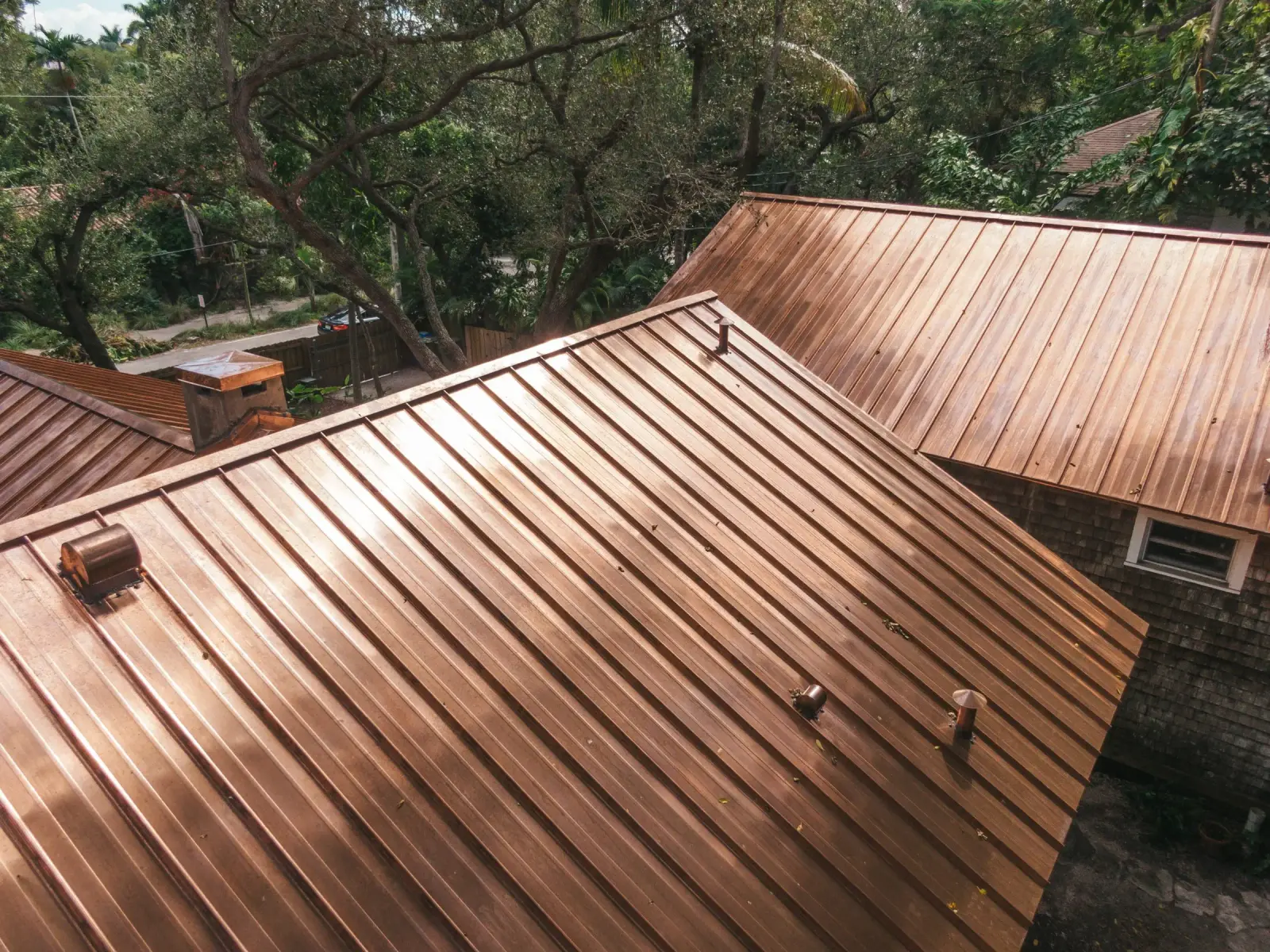
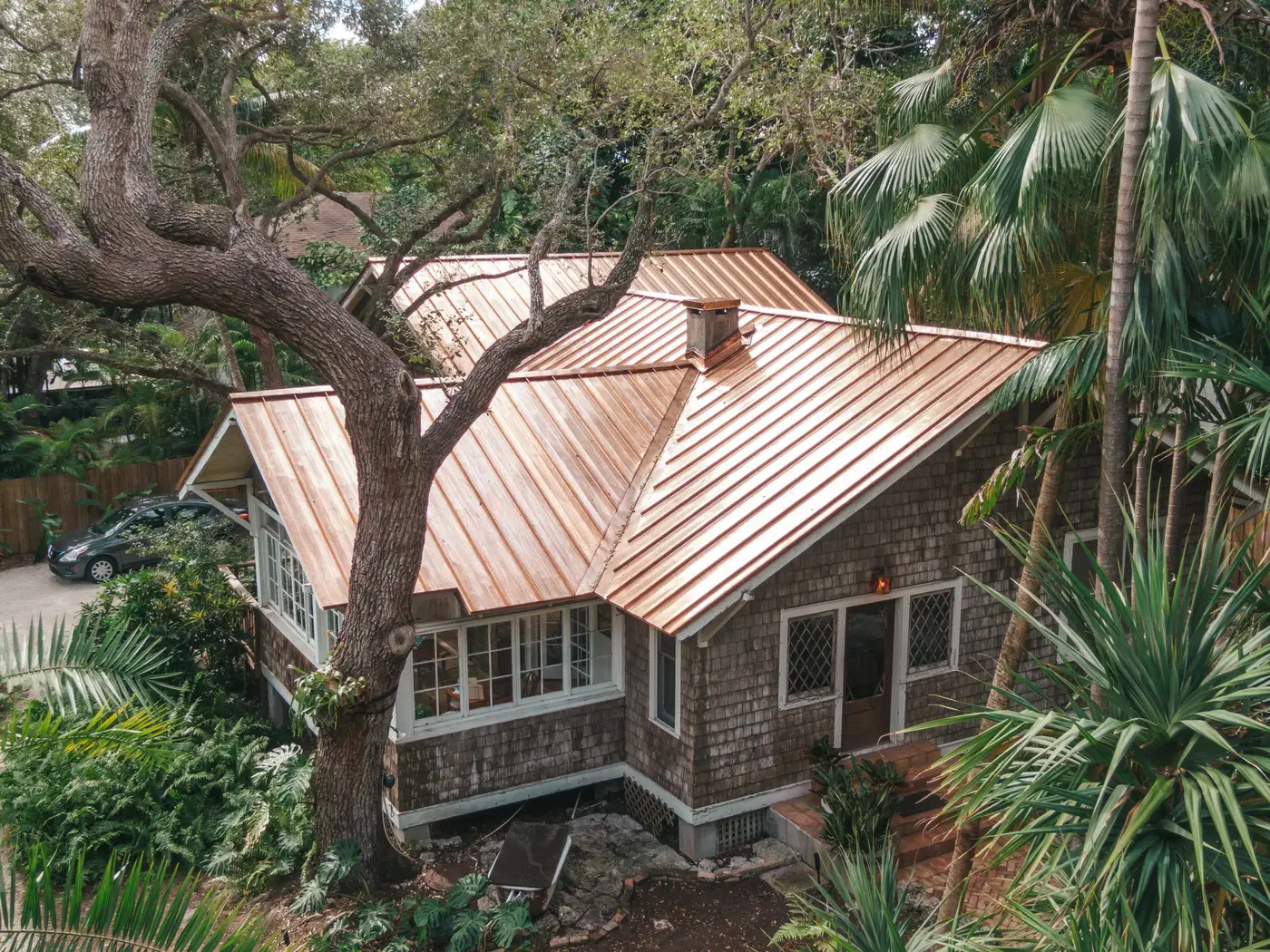
Copper roofing in Coconut Grove lasts decades and looks good doing it. We've been installing it here since 1985: mostly for people who want something that won't need replacing in 20 years and can handle salt air without falling apart.
How Long Does Copper Roofing Last in Coconut Grove?
Copper roofs last 30+ years if installed right. The material forms a patina layer that protects it from salt air, which eats through a lot of other roofing in coastal South Florida. Unlike painted metal that needs recoating every decade or so, copper's oxidation does the work on its own.
Decking condition, structural issues, ventilation: all of it gets verified before material shows up.
COASTAL DURABILITY
Why Copper Works in Coconut Grove
Coconut Grove sits a mile from Biscayne Bay. Salt air is constant, and it corrodes most roofing faster than you'd expect. Copper handles it differently: the patina that develops over 7 to 15 years acts as a barrier against moisture and salt.
The neighborhood has 1920s Mediterranean revival homes, mid-century modern houses, and newer construction. Copper works with all of it. Standing seam for clean modern lines. Batten seam for traditional detailing. Flat-lock panels when the roof geometry gets complicated.
The tree canopy here creates its own issues. Copper handles leaves and branches better than painted metals because there's no coating to scratch through. The patina keeps forming no matter what lands on it.
Coconut Grove is Miami's oldest continuously inhabited neighborhood, with building stock that runs from the 1890s near The Barnacle Historic State Park to contemporary bay-front construction. That range is why copper fits so many Grove roofs: it reads as period-correct on the 1920s Mediterranean revival homes where the metal was historically worked into valleys and cresting, and it reads as intentional on the modern houses where a clean standing-seam plane is the point.
Many of the older homes here carry a structural constraint copper happens to answer. Framing on early Grove houses was often never sized for tile or heavy systems, and some carry multiple roof layers from past re-roofs. Copper's weight sits close to clay tile and below concrete tile, so it can replace a failed heavy roof without the reframing a fresh tile system would trigger once the old layers come off.
Salt exposure is the constant. The bay sits on the neighborhood's eastern edge, and homes within a half-mile of the water see the fastest corrosion on any exposed metal. Copper answers that by not rusting at all, and by taking only copper or stainless-steel fasteners and flashing so no dissimilar metal sets up galvanic corrosion in the salt air.
INSTALLATION PROCESS
How We Install Copper in Coconut Grove
We start by checking the substrate. Decking condition, structural issues, ventilation: all of it gets verified before material shows up. Older homes in Coconut Grove often need decking reinforcement or ventilation upgrades to meet current code.
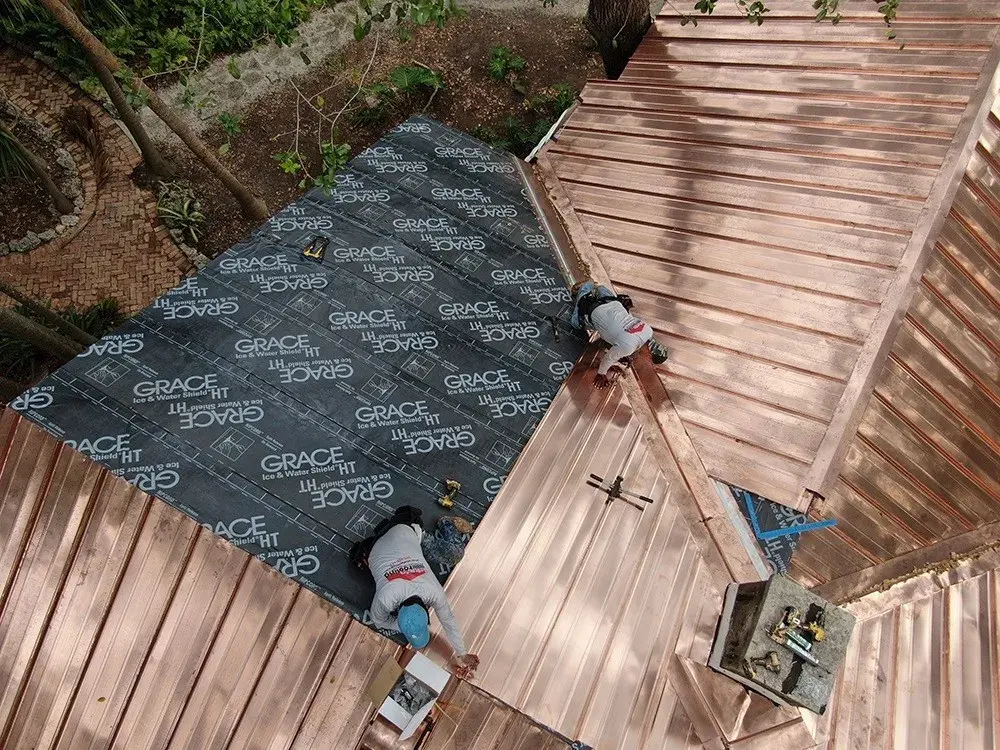
Underlayment goes in per manufacturer specs for the copper profile. Standing seam needs slip-sheet underlayment for thermal expansion. Batten seam and flat-lock use high-traction underlayment to keep panels stable. We run a high-temperature synthetic membrane with generous overlaps and keep bituminous products off the assembly, since asphalt-based underlayments react with copper and can stain or corrode the panel from below over the decades a Grove copper roof is meant to last.
We fabricate standing seam and batten seam panels on-site. Measure each roof plane, account for thermal movement, form panels to exact dimensions. Flat-lock and specialty profiles arrive pre-fabricated.
Flashing gets the most attention. Copper expands and contracts with temperature: bad flashing creates leaks within a year. We use expansion joints at panel terminations, soldered seams at critical junctions, mechanical fastening where thermal movement is minimal.
On the bay-facing Grove roofs, we carry the copper through the entire water path. Concealed clips seat at roughly 12-inch intervals, and where the roof drains we specify copper gutters and downspouts rather than aluminum, so the salt air never finds a dissimilar-metal junction to corrode. Soldered valleys run about a foot under the panel on each side, which keeps wind-driven rain off the deck during the afternoon storms that roll in off Biscayne Bay.
Final inspection covers fastener engagement, seam integrity, flashing continuity, drainage flow. Coconut Grove's afternoon storms test the work immediately. Proper slope, secure attachment, complete flashing coverage keep water out during the first rain.
MATERIAL COMPARISON
Copper vs. Other Metal Roofing Options
Material
Lifespan
Patina Development
Coastal Performance
Relative Cost
Copper
30+ years
Natural verde patina, 7-15 years
Excellent: self-protecting oxide layer
Premium
Aluminum
30+ years
None; painted finish
Good with Kynar coating, requires recoating
Mid-range
Galvalume
30+ years
None; metallic coating
Moderate: zinc layer depletes in salt air
Economical
Zinc
30+ years
Natural gray patina, 5-10 years
Excellent: similar to copper
Premium
MATERIAL APPROACH
Copper Roofing Across Coconut Grove's Architecture
Copper's three working profiles map onto the range of homes the Grove holds. Standing-seam copper suits the clean rooflines of the neighborhood's contemporary bay-front builds; batten-seam gives the raised shadow lines that flatter the 1920s Mediterranean revival homes where the metal was historically worked into valleys and cresting; and hand-formed flat-lock follows the complex hips, dormers, and transitions where a rigid panel run will not sit right. The metal stays the same across all three, so the profile is chosen to fit the house rather than the other way around.
The Grove's setting drives the detailing more than the panel does. On waterfront blocks, copper gutters and downspouts carry the whole assembly in a single metal so no dissimilar-metal contact can start a galvanic problem, and parapet and multi-level drainage points get soldered flashing rather than sealant. On the older interior streets, framing sized for the original roof is checked before any copper is loaded, since the metal sits heavier than shingle though lighter than tile.
Because the Grove's roof geometries are rarely simple, standing-seam copper on these homes is often fabricated and formed on-site rather than shop-prefabricated, so each panel and flashing detail is measured to the actual roof plane.
MANUFACTURER CERTIFICATIONS
Metal Roofing Credentials
We're certified applicators with Englert, PAC-CLAD, and Berridge. The certifications require ongoing training in installation techniques, material handling, and warranty compliance.
Copper is unforgiving of loose detailing, so our metal roofing work on copper is built around the parts that decide the roof's life: soldered flashing integration, room for thermal movement at every seam and termination, and architectural detailing matched to the home's period.
We're members of the National Roofing Contractors Association and participate in technical committees on metal roofing standards and coastal installation practices.
WHAT TO EXPECT
Warranty and Long-Term Expectations
Copper warranties cover material defects and installation workmanship. Material warranties from copper suppliers run 30 to 50 years, covering perforation and structural failure. Our installation warranty covers workmanship for up to 12 years: flashing leaks, fastener failures, seam separation.
Copper's warranty picture is simpler than a coated metal's, for a structural reason. A galvalume or aluminum roof needs separate substrate and PVDF-paint warranties because a coating is doing the protecting; copper has no coating to warrant. The metal is the durable element and the patina is its finish, so the coverage that matters is the workmanship on the seams, flashing, and fastening that decide whether the roof reaches its full service life.
Copper's appearance changes over time. New installations show bright metallic orange-brown. Within 6 to 12 months, the surface darkens to chocolate brown. The verde patina starts forming after 3 to 5 years in coastal environments, reaching full coverage by year 10 to 15. This is normal and means the patina is developing properly.
Maintenance is minimal. Annual inspections check flashing condition, fastener engagement, drainage flow. Debris removal prevents organic buildup in valleys and behind penetrations. Unlike painted metal, copper needs no recoating or surface treatment: the patina maintains itself.
We've been operating since 1985, which is longer than most copper roof warranties. That provides continuity for warranty claims and long-term service.
Waterfront and historic district install sequence
The Coconut Grove waterfront blocks along Bayshore Drive, the older streets fronting Biscayne Bay, and the historic interior streets around the Pan American Drive corridor each carry their own install considerations. Salt air on the waterfront accelerates copper's patina cycle, shifting full verdigris coverage from the typical 15 to 20 year inland timeline down to 7 to 10 years on roofs within 0.5 mile of the bay. Homeowners who want the bright copper finish to persist longer typically choose interior blocks rather than waterfront properties; homeowners who want patina to develop quickly often appreciate the waterfront's accelerated timeline as a feature rather than a downside.
A typical Coconut Grove copper installation runs seven to twelve days for a standard residential gable or hip roof, longer for the complex geometries common in 1920s Mediterranean revival homes with their hipped tile transitions, dormers, and copper-clad architectural accents. Day one covers tear-off and structural inspection, with particular attention to rafter spans on older homes whose framing may have been sized for the original tile system. Day two installs synthetic high-temperature underlayment and self-adhered ice-and-water shield at eaves, valleys, and penetrations. Days three through eight handle field panel fabrication and installation, often on-site for standing-seam profiles because the variable roof geometry on older Grove homes makes shop pre-fabrication unreliable.
Design review process and historic-district approvals
Properties within the Coconut Grove historic overlay districts require design review approval before any roofing scope visible from the right-of-way can proceed. The review typically takes 3 to 6 weeks depending on the review board's calendar and the project's complexity. Submission packages need a copper sample (typically a 4 by 6 inch panel showing both the bright finish and a swatch demonstrating the expected patina progression), a finish chip from the manufacturer's coil stock, a roof-plane diagram showing seam direction, and flashing detail drawings at every transition.
Copper standing-seam and batten-seam profiles generally receive favorable review for Mediterranean revival and Spanish Colonial homes because the material was historically used in these styles for valleys, gutters, finials, and decorative cresting. Flat-lock copper is more common on contemporary infill within the historic context, where the flatter profile reads more as a modern interpretation than a period-correct restoration. We provide the documentation packages design review boards need, and we coordinate the architectural review timeline with the broader install sequence so the permit issuance, design approval, and material lead time align rather than delaying the project at the final inspection stage.
Cost considerations for Coconut Grove copper installations place copper at the premium end of the metal roofing market, with waterfront homes near Bayshore Drive and properties inside the historic overlay landing toward the upper end of the range due to design-review submission costs, longer lead times on custom-fabricated trim profiles, and the heavier-gauge 20-ounce copper specified for the highest-exposure roofs. We provide a detailed itemized quote at consultation that separates material, fabrication, labor, permits, and design-review fees so the homeowner can see exactly where the project's budget lands across each scope component.
Homeowners weighing copper against the rest of the metal lineup often compare it to aluminum roofing in Coconut Grove, which sits well below copper on the price ladder while still meeting HVHZ standards, and Galvalume roofing in Coconut Grove, which carries the same 30+ year service life at the most economical point on the metal price ladder. The full neighborhood scope of materials and services we install in the Grove is documented on Istueta's Coconut Grove roofing services page.
My consultation with Ricardo went very well he explained to me about the company the products they use and what set their company above from other companies he was very professional and polite and by the way I found this company on Facebook how about that the products they use are high quality products which is what I'm looking for can't wait to get this project started talk to you soon Ricardo
a month ago
Miguel
★★★★★
(Translated by Google) Sofia is very professional and demonstrates knowledge of the work her company performs.
(Original)
Sofia, muy profesional y muestra conocimiento del trabajo que ejecuta su compañia
a month ago
Roberto Ramos
★★★★★
(Translated by Google) Sofia provided excellent and very professional service.
(Original)
Muy buena atencion de Sofia y muy profesional.
a month ago
Armando Lopez
★★★★★
We had the pleasure to be attended by Sofia excellent knowledge, very patient and easy to talk to and give us the important information that we need to make the correct decision.
a month ago
Rebecca Sterling Rosengarten
★★★★★
Thank you Sophia for a thorough inspection for my roof maintenance! Especially for inspecting inside the attic in the summer!
Also, since my house stays too hot she recommended solar vents which apparently my home has no vents other than soffit vents. Looking forward to istueta installing them.
2 months ago
Jorge Kasabdji
★★★★★
⭐⭐⭐⭐⭐
Great experience with Sofia on my roof replacement. She knew her product, explained pricing and options clearly, and was never pushy. Smooth process from quote to follow-up. Highly recommend asking for her.
a month ago
Jose Porras Mesa
★★★★★
(Translated by Google) Miss Sofia is super professional and very attentive, thank you very much
(Original)
La señorita Sofía es súper profesional y muy atenta ,muchas gracias
a month ago
Lina Darsa
★★★★★
Solar vent installation. Exceptional customer service. Friendly knowledgeable reliable. Early to appointment
4 days ago
Mario Alfano
★★★★★
I contacted the company for a quote on re-roofing. Ramon Alvarez carried out the site visit right on schedule and with great attention to detail. The quote I received is extremely detailed; every cost item is clear and well-explained. The prices are in line with the market given the quality offered, and they were very helpful in clarifying any questions I had about the materials. Highly recommended!
2 months ago
javier perez
★★★★★
(Translated by Google) Very professional and very respectful
(Original)
Muy profesionar y muy respetuoso
2 months ago
James Mincey
★★★★★
My consultation with Ricardo went very well he explained to me about the company the products they use and what set their company above from other companies he was very professional and polite and by the way I found this company on Facebook how about that the products they use are high quality products which is what I'm looking for can't wait to get this project started talk to you soon Ricardo
a month ago
Miguel
★★★★★
(Translated by Google) Sofia is very professional and demonstrates knowledge of the work her company performs.
(Original)
Sofia, muy profesional y muestra conocimiento del trabajo que ejecuta su compañia
a month ago
Roberto Ramos
★★★★★
(Translated by Google) Sofia provided excellent and very professional service.
(Original)
Muy buena atencion de Sofia y muy profesional.
a month ago
Armando Lopez
★★★★★
We had the pleasure to be attended by Sofia excellent knowledge, very patient and easy to talk to and give us the important information that we need to make the correct decision.
a month ago
Rebecca Sterling Rosengarten
★★★★★
Thank you Sophia for a thorough inspection for my roof maintenance! Especially for inspecting inside the attic in the summer!
Also, since my house stays too hot she recommended solar vents which apparently my home has no vents other than soffit vents. Looking forward to istueta installing them.
2 months ago
Jorge Kasabdji
★★★★★
⭐⭐⭐⭐⭐
Great experience with Sofia on my roof replacement. She knew her product, explained pricing and options clearly, and was never pushy. Smooth process from quote to follow-up. Highly recommend asking for her.
a month ago
Jose Porras Mesa
★★★★★
(Translated by Google) Miss Sofia is super professional and very attentive, thank you very much
(Original)
La señorita Sofía es súper profesional y muy atenta ,muchas gracias
a month ago
Lina Darsa
★★★★★
Solar vent installation. Exceptional customer service. Friendly knowledgeable reliable. Early to appointment
4 days ago
Mario Alfano
★★★★★
I contacted the company for a quote on re-roofing. Ramon Alvarez carried out the site visit right on schedule and with great attention to detail. The quote I received is extremely detailed; every cost item is clear and well-explained. The prices are in line with the market given the quality offered, and they were very helpful in clarifying any questions I had about the materials. Highly recommended!
2 months ago
javier perez
★★★★★
(Translated by Google) Very professional and very respectful
(Original)
Muy profesionar y muy respetuoso
2 months ago
Reviews sourced from Istueta Roofing's verified Google Business Profile.
· See them all →
Begin
Copper Roofing Coconut Grove built for the coast.
Schedule a no-pressure consultation. We walk your roof, review your options, and give you a detailed written proposal.