
Sophia was here did a great job talked about my roof and we have to wait on insurance but great prices thank you Sophia for everything
2 weeks ago
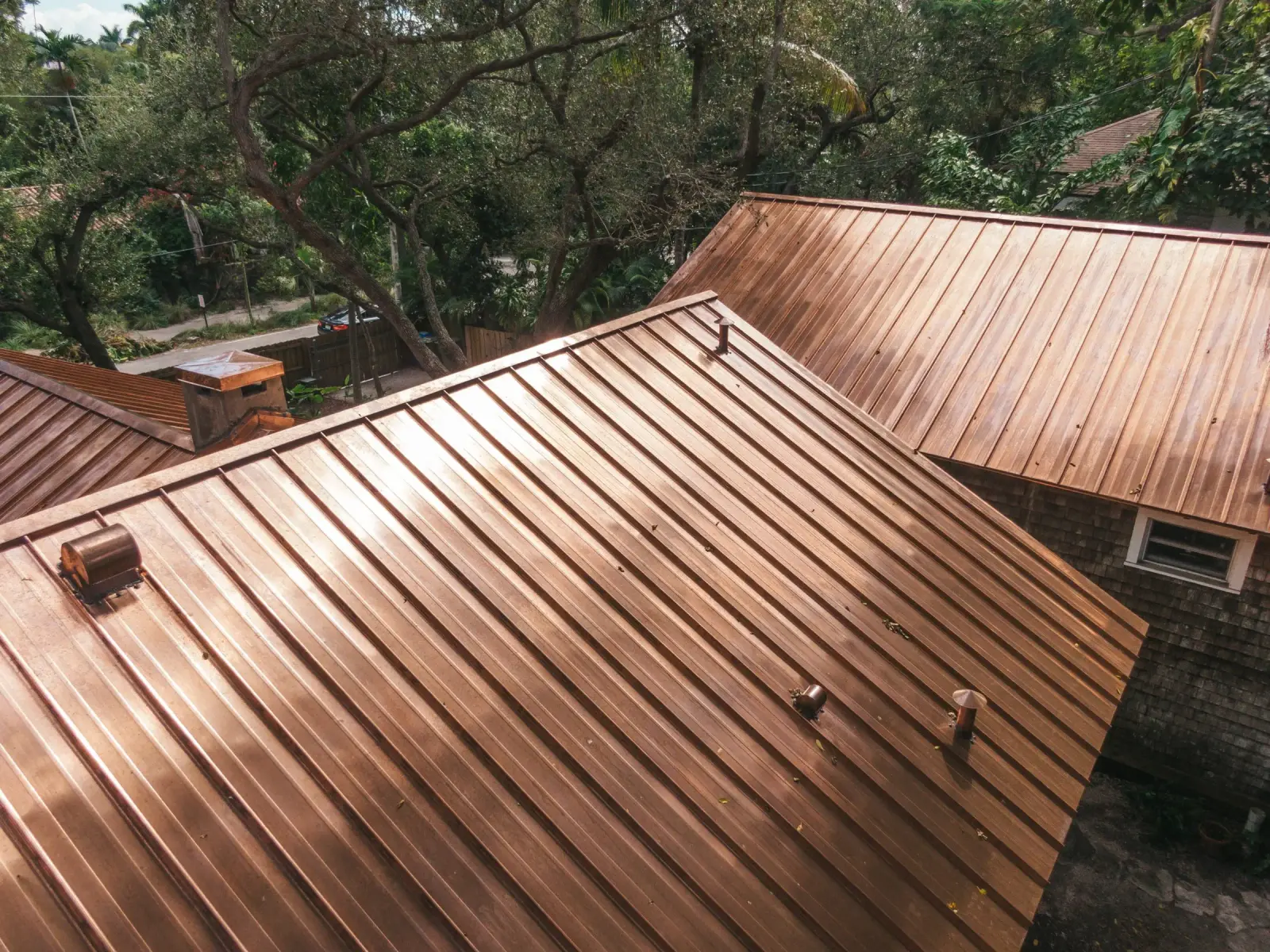
Copper roofing in Pinecrest's inland setting typically lasts 30+ years when standing-seam systems are properly detailed. The material's natural verdigris patina develops over the first 20 to 30 years, creating a protective layer that resists humidity and the tree-canopy moisture common in Pinecrest. Homes in this area often feature Mediterranean and contemporary designs where copper's evolving appearance complements both traditional and modern aesthetics.
Copper roofs in Pinecrest's inland setting commonly reach 30+ years of reliable service when standing-seam systems are properly detailed, because copper develops a natural verdigris patina over the first 20 to 30 years that seals the surface against further corrosion. Unlike steel-based metals that require coatings, copper's natural oxidation creates a self-renewing barrier against humidity and airborne salinity. Pinecrest homes benefit from copper's dimensional stability across temperature swings and its resistance to the biological growth common in shaded, humid microclimates.
Copper installation requires specialized tools and techniques that differ from standard metal roofing work.
Pinecrest's building stock includes Mediterranean revival homes from the 1950s through 1970s, contemporary estates, and transitional designs where architectural detail matters. Copper roofing integrates with these styles through standing-seam profiles, batten-seam configurations, and flat-seam applications that follow complex roof geometries.
The neighborhood sits 8 to 12 miles inland from Biscayne Bay, far enough to avoid direct salt spray but close enough that humidity and airborne salinity affect material performance. Copper handles this exposure without the coating failures common to painted metal systems. The patina develops gradually, shifting from bright copper to brown tones and eventually to the green verdigris over 15 to 25 years.
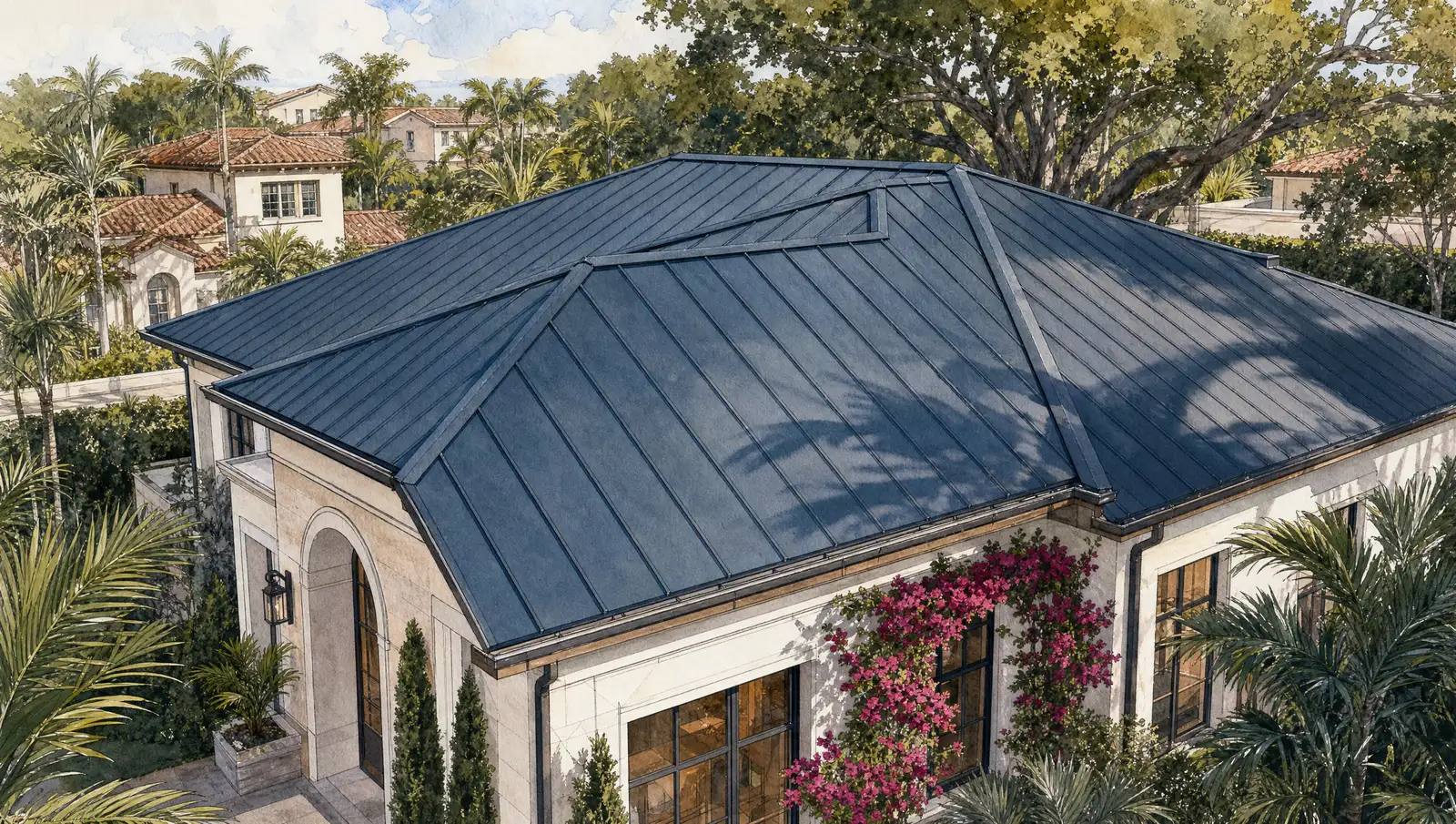
Pinecrest's tree canopy creates shaded roof sections where moisture lingers. Copper resists the algae and mildew growth that affects organic roofing materials in these conditions. The metal's thermal conductivity also helps manage attic temperatures, reducing cooling loads during summer months.
Local permitting follows Miami-Dade County standards, which require engineered drawings and product approvals for metal roofing systems. Copper installations typically use concealed fastener profiles that meet High-Velocity Hurricane Zone requirements when properly detailed. We coordinate these submissions as part of the installation process.
Pinecrest incorporated as a village in 1996, four years after Hurricane Andrew crossed South Miami-Dade in August 1992, and much of the housing stock copper now replaces dates to the decades on either side of that storm. Copper standing-seam systems detailed with concealed clips meet the post-Andrew fastening standards the area adopted, the same engineering that governs metal roofing across Miami-Dade today. On the older homes that predate those standards, copper's weight sits close to clay tile and below concrete tile, so a homeowner can move to a long-service metal without the reframing a heavier tile system can demand.
The village earned its Tree City USA designation on the strength of more than 10,000 street trees planted since 1997, and that canopy is where copper separates from the coated metals. Copper carries no paint film for a falling branch or a seed pod to scratch through, so the debris that collects on shaded Pinecrest slopes never reaches a substrate the way it can on painted steel. The patina keeps advancing under leaf litter and shade because it is the copper itself oxidizing, not a coating sitting on top of it.
Copper's three working profiles map onto Pinecrest's mixed streets. Standing-seam suits the clean rooflines of the contemporary builds in the village's newer subdivisions, batten-seam gives the raised shadow lines that flatter the 1950s-through-1970s Mediterranean homes, and hand-formed flat-seam follows the complex hips and dormers where a rigid panel run would not sit right. The metal stays the same across all three; only the seam detail changes with the house.
| Material | Lifespan | Patina/Finish | Relative Cost | Best Application |
|---|---|---|---|---|
| Copper | 30+ years | Natural patina develops over decades | Premium | Historic homes, architectural statements, coastal exposure |
| Aluminum | 30+ years | Factory finish or mill finish; no patina | Mid-range | Coastal areas, lightweight requirements, budget-conscious projects |
| Galvalume | 30+ years | Metallic gray finish; coating protects steel core | Economical | Agricultural, commercial, residential where appearance is secondary |
| Zinc | 30+ years | Gray patina develops; self-healing properties | Premium | Contemporary designs, European aesthetic preferences |
Copper installation requires specialized tools and techniques that differ from standard metal roofing work. The material is soft compared to steel-based metals, which means it dents easily during handling but also allows for hand-forming complex details.
We begin with a full roof inspection and measurement. Copper systems require precise panel lengths to accommodate thermal movement. Panels expand and contract with temperature changes, so clip spacing and fastener placement follow engineered specifications rather than field judgment.
Underlayment selection matters with copper. Bituminous products can react with the metal, causing staining and accelerated corrosion. We use synthetic or rubberized underlayments that provide a neutral barrier between the copper and the roof deck.
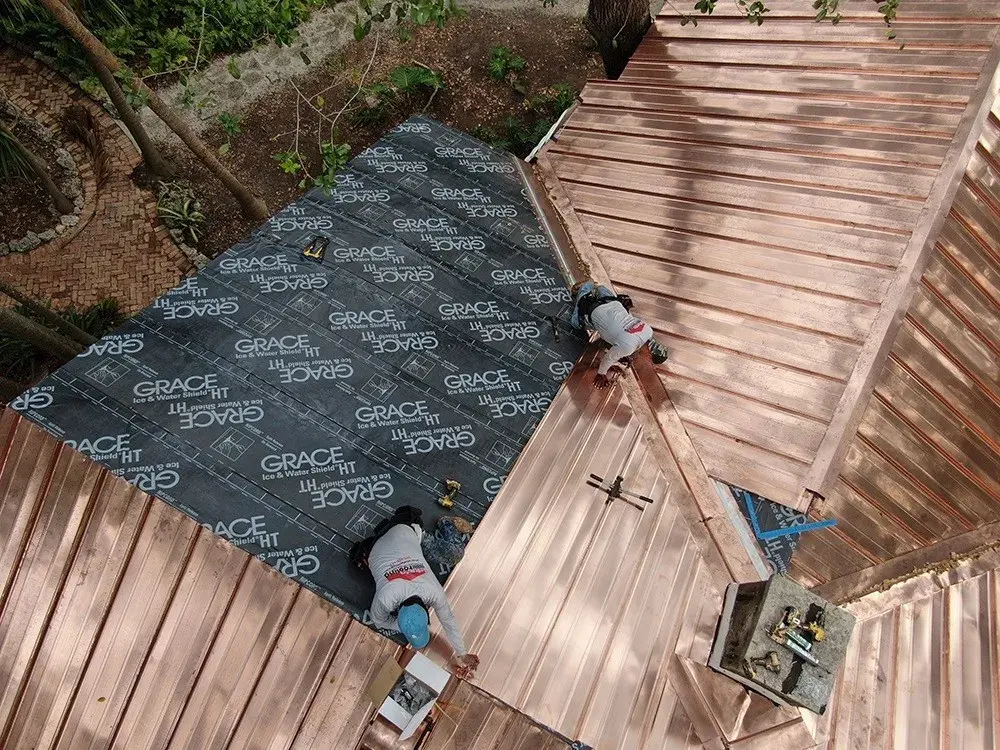
Panel installation follows the roof's geometry. Standing-seam profiles use concealed clips that allow the panels to move independently. Batten-seam systems add a raised cap over the seam, creating shadow lines that emphasize the roof's form.
Flat-seam applications involve hand-forming each panel and soldering the joints, a traditional technique used on complex roof shapes and historic restorations.
Flashing details get particular attention. Copper expands at a different rate than surrounding materials, so transitions to walls, chimneys, and penetrations require expansion joints and proper lapping sequences. We avoid mixing copper with dissimilar metals that can cause galvanic corrosion.
Clip spacing follows the engineered schedule, with concealed clips set at roughly 12-inch intervals along each seam so the panel moves with temperature while the fasteners stay locked to the deck. On the soldered seams and flat-seam sections, the solder joint resists both capillary draw and the wind-driven rain that arrives with Pinecrest's summer storm bands, which is why we solder those details rather than rely on sealant. Fastening and flashing stay copper or stainless steel throughout, never aluminum or galvanized hardware, because dissimilar metals corrode where moisture bridges them against copper.
Valley flashing is formed from the same copper stock and soldered at the seams, running about 12 inches under the panel on each side so water tracking off the canopy-shaded slopes stays on top of the metal. Where the roof drains to gutters, we specify copper gutters and downspouts with copper or stainless hangers so the entire water path stays one metal family. Dropping a copper roof into aluminum or galvanized gutters would set up the same galvanic corrosion the fastener details are built to prevent.
Final inspection confirms that all fasteners are concealed, seams are properly formed, and drainage paths are clear. Copper roofs don't require sealants or coatings. The material protects itself through patina formation, which begins immediately upon exposure to air and moisture.
Copper suits the full spread of Pinecrest's architecture because the profile can change while the metal stays the same. On the village's Mediterranean and hipped-roof homes, standing-seam or batten-seam copper follows the hips and valleys with hand-formed terminations that a rigid, off-the-shelf panel cannot. On the contemporary builds and their flat or low-slope sections, flat-seam copper delivers the watertight performance a minimal pitch needs while holding the clean, unbroken lines those designs are after.
Framing is the first thing we check on any Pinecrest copper roof. Copper sits heavier than asphalt shingles but lighter than concrete tile, so a home shedding an old barrel-tile roof usually has ample capacity, while a structure never built for tile gets a framing check before any metal is loaded. Where a home carries both steep and flat or low-slope sections, the copper field and the low-slope copper are detailed as one assembly so the transition is not the weak point.
Copper roofing projects in Pinecrest often involve homeowner associations and architectural review boards. We provide material samples, finish progression documentation, and installation specifications as part of the approval process. The material's long history and proven performance in South Florida typically satisfy review requirements once the aesthetic direction is established.
Our copper roofing reflects the technical execution and long-term performance standards we apply to every installation: hand-formed valleys and ridges, soldered flashing at transitions, and thermal-movement allowances that let the metal move without stressing its seams.
We maintain certified applicator status with metal roofing manufacturers including Englert, PAC-CLAD, and Berridge. These certifications require ongoing training in material handling, installation techniques, and warranty compliance. We're also members of the National Roofing Contractors Association, which provides access to industry research and technical standards updates.
Our company has been installing roofing systems in South Florida since 1985. We've outlived our own workmanship warranty period 3.5 times, which matters when you're selecting a contractor for a roofing system built to last decades. The families we worked with in the 1980s and 1990s now call us for their children's homes.
The warranty structure on copper differs from the coated metals we install in Pinecrest. A galvalume or aluminum roof carries separate substrate and PVDF-paint warranties because a coating is doing the protecting; copper has no coating to warrant. The metal itself is the durable element, the patina is its finish, and our workmanship warranty covers the seams, the flashing, and the concealed fastening that decide whether the metal actually reaches its full service life.
Copper is the longest-lasting metal roofing option, but it's not the only metal system we install in Pinecrest. Material selection depends on budget, aesthetic preferences, and performance priorities.
Aluminum roofing offers coastal corrosion resistance at a lower cost than copper. The material is lighter than copper, which can matter on homes where roof framing wasn't designed for heavy loads. Aluminum systems typically last 30+ years with factory finishes that maintain their appearance without patina development.
We install aluminum standing-seam systems on homes where the homeowner wants metal roofing performance without copper's upfront cost.
Galvalume roofing uses a steel core with a zinc-aluminum coating that provides corrosion protection. The material costs less than copper or aluminum but requires more maintenance in coastal environments. Galvalume works well for homes farther inland or where budget constraints make copper or aluminum impractical.
The metallic gray finish suits contemporary and industrial design aesthetics.
Standing-seam metal roofing describes the panel profile rather than the material. We install standing-seam systems in copper, aluminum, and Galvalume, depending on the project requirements. The concealed fastener design provides clean lines and allows for thermal movement, which matters in South Florida's temperature swings.
Each metal roofing material has specific installation requirements, warranty terms, and maintenance expectations. We walk through these considerations during the consultation process so you can make an informed decision based on your home's needs and your long-term plans.
For more information about copper roofing, see our copper roofing guide.
Schedule a no-pressure consultation. We walk your roof, review your options, and give you a detailed written proposal.