
(Translated by Google) Thanks to their good prices, quality, and work guarantee, I am now a satisfied customer. Thank you. (Original) Gracias a sus buenos precios, calidad y garantía del trabajo, hoy soy un cliente satisfecho. Gracias
4 weeks ago
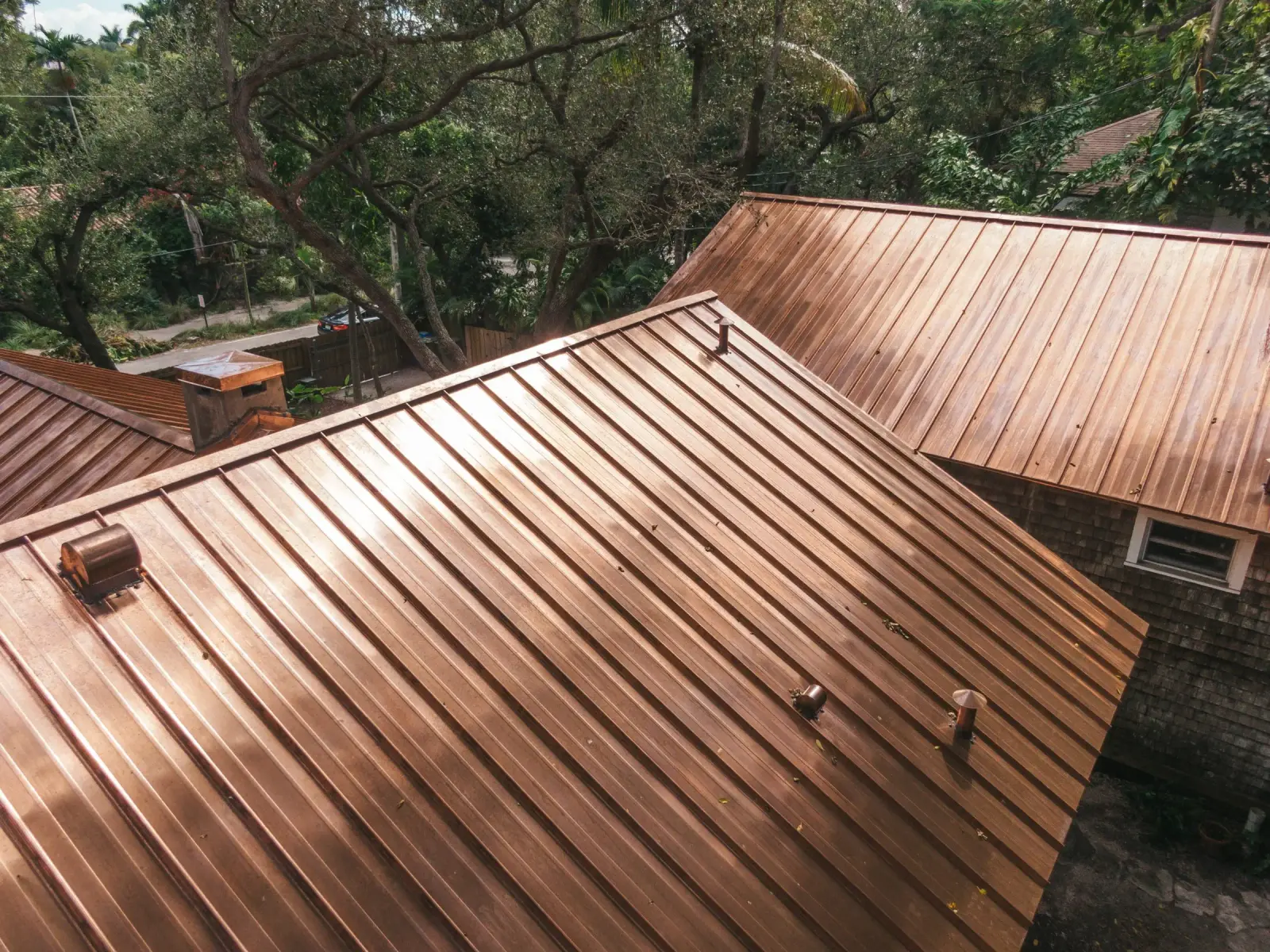
Copper roofing in Coral Gables combines architectural heritage with coastal durability. The material's natural patina development complements Mediterranean Revival and historic home styles while providing long-term protection against salt air and storm exposure. We've installed copper roofing systems across South Florida since 1985, working with homeowners who value craftsmanship and performance that lasts generations.
Copper roofing holds up well in Coral Gables' coastal environment. The material forms a protective patina that resists salt air corrosion while maintaining structural integrity for 30+ years. Historic preservation guidelines in Coral Gables often favor copper for its architectural authenticity and visual consistency with Mediterranean Revival design standards.
We verify that roof framing can support the material weight.
Coral Gables' Mediterranean Revival architecture and historic preservation standards create specific requirements for roofing materials. Copper meets these requirements while addressing coastal exposure challenges.
The material's patina development provides natural corrosion resistance without requiring protective coatings. This makes copper particularly suitable for homes within three miles of Biscayne Bay, where salt air accelerates deterioration of other metals.
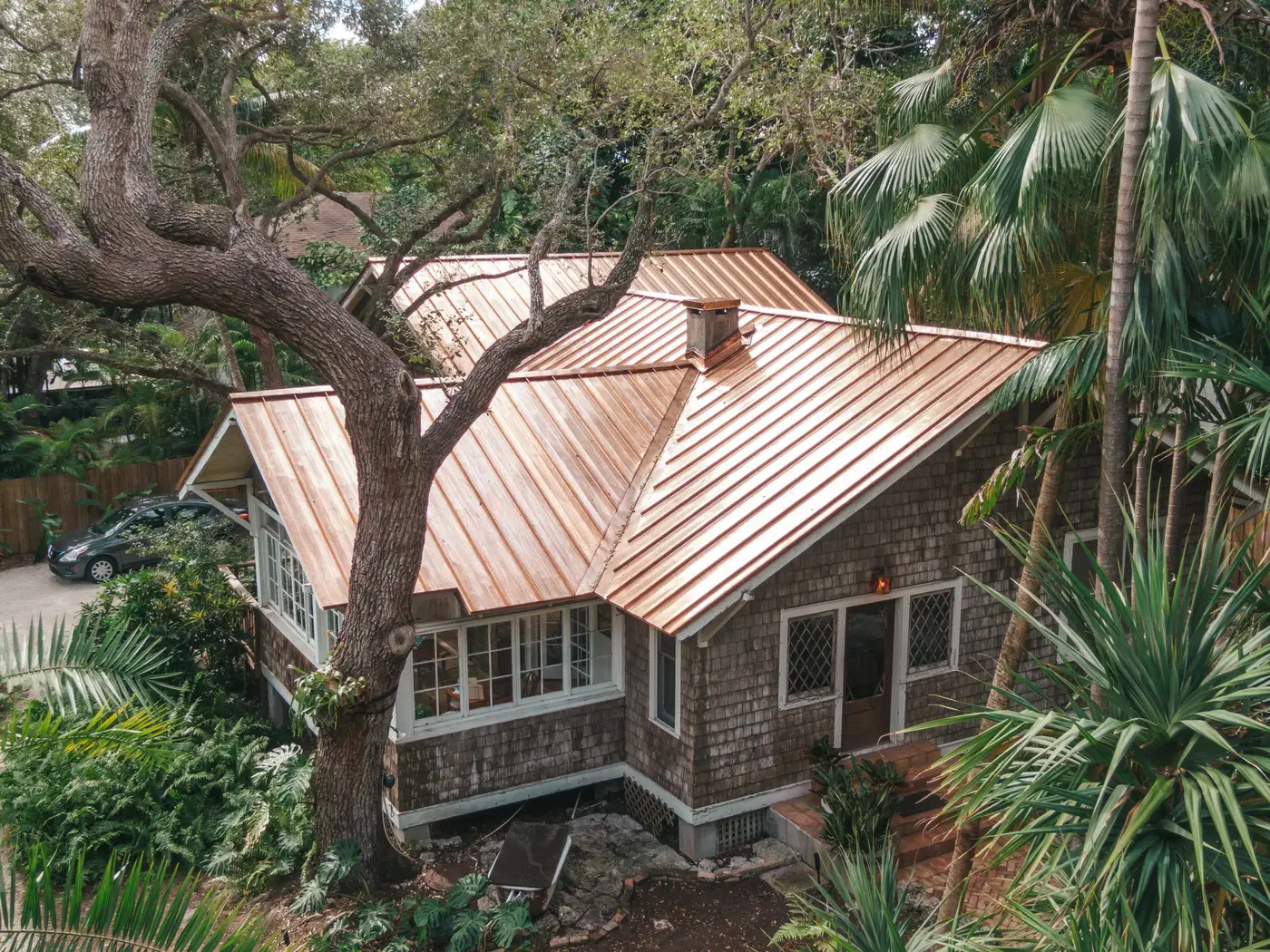
Historic district guidelines in Coral Gables often specify copper for flashing, valleys, and decorative elements on landmark properties. The material's visual consistency with original construction details helps homeowners maintain architectural authenticity while upgrading performance.
Coral Gables was planned around Mediterranean Revival architecture from the start, with Miami Limestone walls under coral-colored Ludowici tile, and copper belongs to that vocabulary. The material was historically worked into the valleys, gutters, finials, and decorative cresting of exactly these styles, which is why the Board of Architects tends to approve it readily on landmark homes. On a house whose original tile has failed, copper also swaps in near clay's weight and below concrete tile's, so the roofline can change materials without reframing.
The salt that moves inland from Biscayne Bay, two miles east, sets the hardware rule. Copper does not rust in that air, but it will corrode a dissimilar metal it touches, so we flash and fasten these Gables roofs with copper or stainless steel only and carry the water path through copper gutters where the hipped roofs and valleys drain.
| Material | Coastal Performance | Lifespan | Patina | Maintenance |
|---|---|---|---|---|
| Copper | Self-protecting patina resists salt air | 30+ years | Natural verdigris develops over time | Minimal; no coating required |
| Aluminum | Oxide layer provides corrosion resistance | 30+ years | No patina; maintains original finish | Periodic inspection of fasteners |
| Galvalume | Zinc-aluminum coating degrades in salt air | 30+ years coastal | No patina; coating wears | Requires monitoring for coating failure |
| Steel (painted) | Requires intact coating for protection | 30+ years coastal | No patina; paint degrades | Recoating needed every 10-15 years |
Copper installation begins with structural assessment. We verify that roof framing can support the material weight. Sixteen-ounce copper weighs approximately 1 pound per square foot, which is lighter than tile but heavier than asphalt shingles. Decking must be solid and properly fastened.
Underlayment installation follows manufacturer specifications. We use synthetic underlayment rated for metal roofing, with slip-resistant surfaces that provide safe footing during panel installation. Underlayment laps are sealed to create a secondary water barrier.
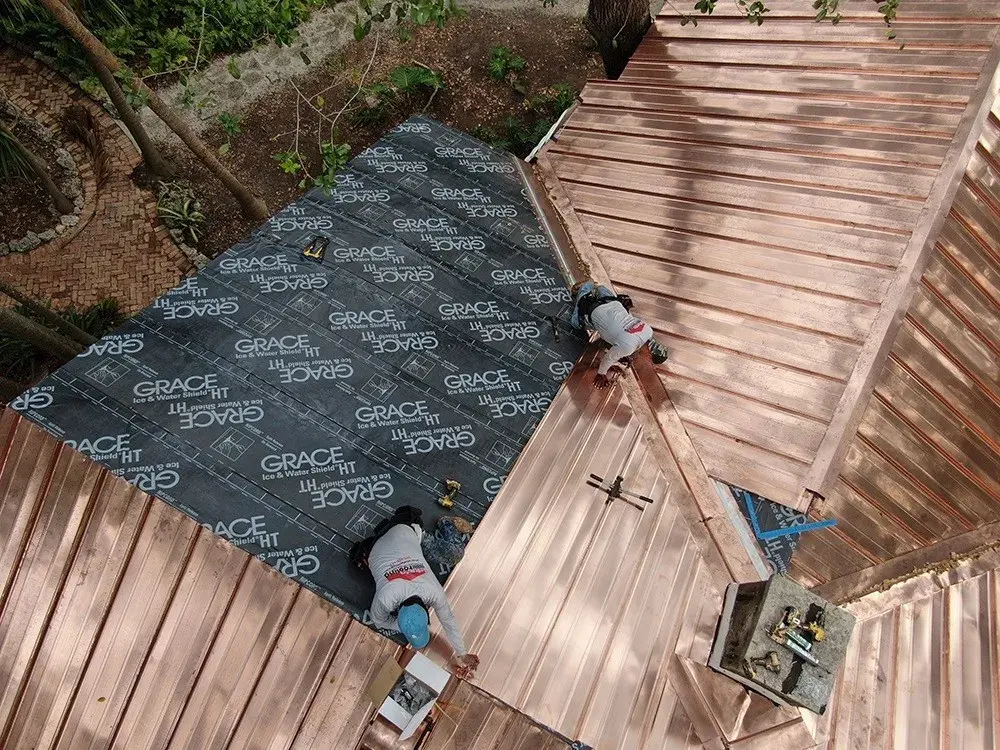
Panel fabrication happens on-site when possible, which eliminates transportation damage and allows custom fitting to roof geometry. Standing-seam panels are formed to exact lengths, with seams oriented to shed water down-slope. Clips are positioned to allow thermal expansion while maintaining wind uplift resistance.
Flashing details get the most attention. Copper flashing at valleys, chimneys, skylights, and wall intersections must be fabricated to match panel thickness and allow independent movement. We avoid mixing copper with dissimilar metals, which can cause galvanic corrosion. When connections to other materials are unavoidable, we use isolation barriers.
Seam engagement is verified as panels are installed. Mechanically seamed systems use a seaming tool that folds the panel edges together in a weathertight lock. Snap-lock systems rely on clip engagement, which we verify at each fastener location.
Final inspection covers fastener spacing, seam engagement, and flashing integration to confirm the system meets wind uplift and water-shedding requirements.
Coral Gables requires building permits for all roof replacements. The city's Building Department reviews plans for compliance with the Florida Building Code and Miami-Dade County's HVHZ provisions. Copper roofing systems must carry a Miami-Dade Notice of Acceptance (NOA) for wind uplift performance.
Historic district projects require additional Board of Architects review. The board evaluates material appropriateness, color compatibility, and architectural impact. Copper's natural patina progression typically gets approval for Mediterranean Revival and Spanish Colonial homes, as the material was historically used in these styles.
Permit applications include structural calculations, product specifications, and installation details. We submit manufacturer data sheets, NOA documentation, and fastening schedules as part of the permit package. Inspection occurs at deck preparation, underlayment installation, and final completion stages.
Our copper work carries the same certified-applicator standards we hold with metal manufacturers like Englert, PAC-CLAD, and Berridge, applied to the metal roofing detailing that decides a copper roof's life: soldered flashing, thermal-movement allowances, and hand-formed valley and ridge work.
We hold certified applicator status with metal manufacturers including Englert, PAC-CLAD, and Berridge. This certification requires demonstrated proficiency in standing-seam installation techniques and ongoing training in material-specific best practices.
We also hold Ludowici Elite Crown installer status, which supports our work on high-end installations where copper roofing pairs with clay tile elements.
Our workmanship warranty extends up to 12 years, backed by four decades of continuous operation. This longevity provides practical reassurance for homeowners making a multi-generational roofing investment. See manufacturer warranty certificate for coverage terms and conditions.
Copper roofing requires minimal maintenance compared to other roofing materials. The patina layer that forms over 7 to 20 years is self-renewing: if scratched or damaged, the exposed copper oxidizes and reforms the protective coating. No painting, coating, or surface treatment is needed to maintain structural integrity.
Annual inspections focus on flashing conditions, fastener integrity, and debris removal from valleys and gutters. Copper's softness means it can dent from falling branches or foot traffic, but these cosmetic issues don't compromise weatherproofing. Seam engagement and clip attachment points should be verified every 5 to 10 years to confirm thermal movement hasn't loosened connections.
The material's longevity comes from its corrosion resistance. Unlike steel-based metals that rust through at fastener penetrations, copper maintains its thickness and strength for 30+ years.
We install copper roofing across Miami-Dade and Broward counties, with particular experience in Coral Gables' historic districts and Mediterranean Revival neighborhoods.
Permitting requirements and architectural review processes differ between municipalities. Coral Gables' historic preservation standards are more detailed than those in Pinecrest or Coconut Grove, requiring additional documentation for material approval on landmark properties.
Our service area includes coastal communities where salt air exposure makes copper's corrosion resistance particularly valuable, as well as inland neighborhoods where the material's longevity and architectural character drive selection.
Copper is the longest-lasting choice in our Coral Gables material catalog, but most home replacement projects involve weighing copper against the alternatives. We install the full range of systems in Coral Gables, and the right choice depends on roof geometry, ownership horizon, architectural review constraints, and budget.
For homeowners not planning to hold the property through copper's 30-plus-year service cycle, asphalt shingle roofing in Coral Gables provides a 15-plus-year solution at a small fraction of copper's installed cost. Asphalt also satisfies architectural review on contemporary and transitional homes where copper's patina would visually compete with the design. We walk through the trade-off between upfront cost and service life during the consultation so it is explicit rather than implied.
Homes with low-slope sections, additions, or covered porches frequently require a separate membrane system rather than copper. We coordinate copper standing-seam installation with flat roofing systems in Coral Gables so the transition between the steep copper field and the low-slope membrane is detailed by a single contractor. This keeps responsibility for the tie-in flashing, historically the most common leak point on mixed-slope roofs, with one warranty holder.
Older Coral Gables homes near the Coral Gables Waterway sometimes have a flat or low-slope main roof rather than a steep field. For those structures, flat roof replacement in Coral Gables using TPO, PVC, or modified bitumen often makes more sense than attempting to retrofit a flat-seam copper assembly across a large low-slope plane. Flat-seam copper at scale requires soldered seams over the entire roof field, which pushes its installed cost well above a membrane system that delivers comparable low-slope performance. We walk through both options when the existing roof is below the 3:12 pitch threshold where standing-seam copper performs reliably.
For homeowners considering copper specifically because of its multi-generational service life, the long-term economics typically favor copper on properties held for 20 or more years. A single copper roof can outlast three or more asphalt-shingle replacement cycles, so an owner who stays long enough avoids the repeated cost of re-roofing in a shorter-lived material. That case strengthens on coastal homes, where salt air wears lower-tier metals and shortens shingle life faster than inland Florida. Because copper carries no coating that can fail, a Coral Gables roof near the Waterway or the coast simply patinas and keeps shedding water rather than chalking or peeling the way a painted metal eventually will. We lay out the trade-off between copper's higher upfront investment and its long service life during the consultation so it is clear for your specific roof.
For more information about copper roofing, see our copper roofing guide.
Copper roofing costs more per square foot than aluminum or galvalume, with the total depending on roof complexity, panel profile, and flashing requirements. Historic district projects may incur additional costs for architectural review and specialized installation details. The material's 30+ year lifespan and minimal maintenance requirements offset the higher initial investment compared to other roofing options.
Yes. All roofing work in Coral Gables requires building permits. Properties in historic districts require additional Board of Architects review for material and color approval. We handle permit applications, engineering calculations, and inspection coordination as part of the installation process.
Yes. Copper is often preferred for historic properties because it matches original construction materials and meets preservation guidelines. The material's visual consistency with Mediterranean Revival architecture and its longevity make it suitable for landmark homes requiring authentic restoration.
Yes. Copper flashing and valleys integrate well with clay tile roofing systems common in Coral Gables. We install copper elements on tile roofs to provide durable flashing at roof-to-wall transitions, valleys, and decorative accents. The combination of copper and tile is architecturally consistent with Mediterranean Revival design standards.
Schedule a no-pressure consultation. We walk your roof, review your options, and give you a detailed written proposal.